
Doberman Pinscher Alpha-Mannosidosis (AMAN): A Deep Dive Into This Rare Genetic Disorder
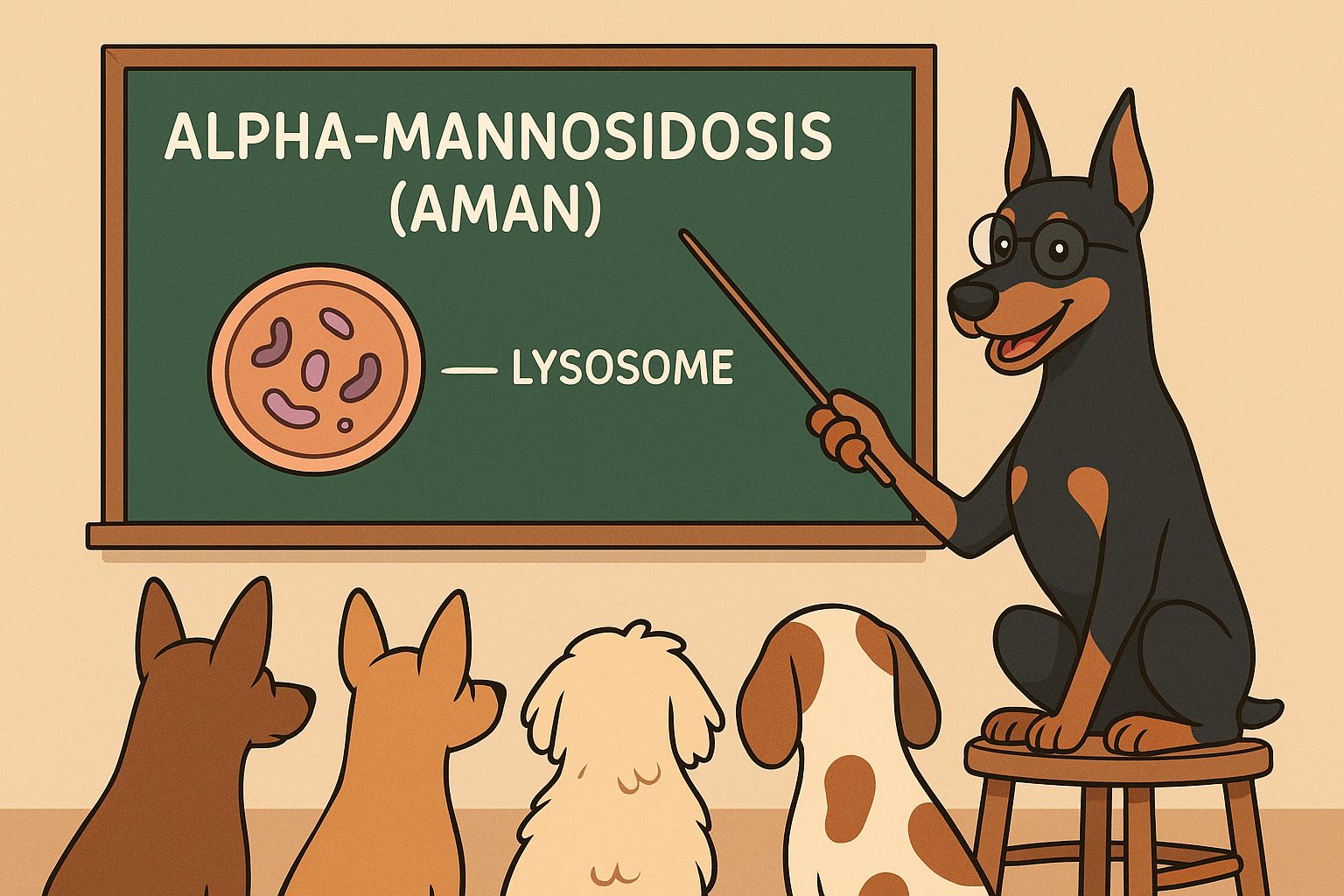
Doberman Pinschers are renowned worldwide for their elegance, intelligence, and loyalty. They are guardians, athletes, and companions rolled into one. But like many purebred dogs, Dobermans carry genetic predispositions to certain health conditions. While most owners are familiar with common issues such as dilated cardiomyopathy (DCM) or von Willebrand’s disease (vWD), few are aware of a devastating condition that, although rare, is critically important to understand: Alpha-Mannosidosis (AMAN).
This article explores Alpha-Mannosidosis in Dobermans: its genetic roots, clinical presentation, progression, diagnosis, treatment options, and what responsible breeders and owners can do to protect future generations. Because it is so rare, information on AMAN in dogs is limited, but by combining veterinary science, genetic research, and responsible breeding practices, we can shed light on this disorder and ensure that it does not silently threaten the Doberman breed.
Table of Contents
What is Alpha-Mannosidosis (AMAN)?
Alpha-Mannosidosis is a lysosomal storage disorder. Lysosomes are tiny compartments inside cells that act like recycling centers—they break down waste products, cellular debris, and complex molecules into simpler forms that the body can reuse. When lysosomes malfunction, waste products build up inside cells, damaging tissues and organs.
In AMAN, the problem lies with the alpha-mannosidase enzyme. This enzyme is responsible for breaking down certain sugars (mannose-rich oligosaccharides) that come from glycoproteins. When the enzyme is missing or defective due to a genetic mutation, these sugars accumulate inside lysosomes. Over time, this accumulation interferes with normal cellular function, especially in the nervous system, skeletal system, and immune system.
In simpler terms: dogs with AMAN cannot properly process certain sugars, leading to a toxic buildup in their cells. The result is progressive neurological decline, bone deformities, organ dysfunction, and eventually death.
Is AMAN Found in Dobermans?
Alpha-Mannosidosis has been reported in several species: humans, cattle, cats, and dogs. In dogs, it has been observed most notably in Doberman Pinschers and Walker Hounds, though cases are rare.
In Dobermans, AMAN is caused by an autosomal recessive mutation. This means that:
- A dog must inherit two copies of the defective gene (one from each parent) to be affected.
- Dogs with only one copy are carriers: they appear healthy but can pass the mutation on to their offspring.
- Dogs with no copies are clear and cannot pass it on.
Because of this inheritance pattern, the disease can remain hidden for generations. If two seemingly healthy carriers are bred together, approximately 25% of their puppies will develop AMAN, 50% will be carriers, and 25% will be clear.
Symptoms of AMAN in Dobermans
The signs of AMAN in Dobermans vary depending on how much residual enzyme activity the affected dog has. Symptoms usually appear in puppies or young adults and tend to worsen with age. Common clinical signs include:
1. Neurological Symptoms
- Ataxia (unsteady gait, wobbliness)
- Intention tremors (shaking when trying to perform movements)
- Weakness in the hind limbs
- Seizures in severe cases
- Learning difficulties or confusion
- Poor coordination and clumsiness
- Head tremors
2. Skeletal and Musculoskeletal Abnormalities
- Abnormally shaped bones (especially long bones and joints)
- Enlarged joints or stiffness
- Delayed growth
- Bone pain or lameness
3. Immune and General Health Issues
- Recurring infections (especially respiratory)
- Enlarged liver or spleen
- Poor body condition despite adequate nutrition
- Hearing loss
4. Behavioral Changes
- Puppies may seem “slow” to learn commands
- Anxiety, nervousness, or withdrawal
- Loss of interest in play as the disease progresses
The age of onset and severity can vary widely. Some Dobermans may live a few years with relatively mild symptoms, while others may deteriorate rapidly.
How AMAN Progresses
Alpha-Mannosidosis is progressive—symptoms worsen over time as more sugar molecules accumulate inside the lysosomes. In Dobermans, the disease generally follows three stages:
- Early Stage (Puppyhood to Young Adult)
Dogs may appear slightly clumsy or slow to learn. Owners may dismiss this as “just the dog’s personality” or poor coordination. Subtle bone abnormalities may start to appear. - Middle Stage (Adolescence to Early Adulthood)
Neurological issues become more apparent: difficulty walking, tremors, frequent stumbling. The dog may begin experiencing recurring infections or show signs of organ enlargement. - Late Stage (Adulthood)
Severe ataxia, possible seizures, pronounced skeletal deformities, significant weakness, and declining quality of life. Without intervention, most affected dogs eventually succumb to complications.
Diagnosis of Alpha-Mannosidosis
Diagnosing AMAN in Dobermans is challenging because the disease is rare and many of its symptoms overlap with other conditions (like cerebellar hypoplasia, degenerative myelopathy, or metabolic bone disease). Veterinarians use several approaches:
1. Clinical Examination
- A thorough neurological exam reveals ataxia, tremors, and weakness.
- Skeletal deformities may be detected via palpation or x-ray.
2. Laboratory Tests
- Urine tests: Detect elevated levels of oligosaccharides (sugar molecules that should have been broken down).
- Enzyme assays: Measure alpha-mannosidase activity in white blood cells or fibroblasts. Affected dogs show drastically reduced enzyme activity.
3. Genetic Testing
- The most definitive method is a DNA test for the known mutation in Dobermans.
- Carriers can be identified before breeding, allowing responsible breeders to prevent producing affected puppies.
4. Imaging
- MRI or CT scans may show brain abnormalities due to storage buildup.
- X-rays may reveal abnormal bone shapes or joint enlargement.
Treatment and Management
Unfortunately, there is no cure for Alpha-Mannosidosis in Dobermans. Once a dog is affected, treatment is supportive and aimed at improving quality of life.
Supportive Care
- Physical therapy to help with mobility.
- Pain management for skeletal abnormalities.
- Antibiotics or antivirals for recurrent infections.
- Anti-seizure medications if seizures occur.
Experimental Treatments
In humans and other species, research is ongoing for:
- Enzyme replacement therapy (ERT) – replacing the missing enzyme via intravenous infusions.
- Bone marrow transplantation (BMT) – replacing defective cells with healthy ones that produce the enzyme.
- Gene therapy – correcting the genetic mutation.
So far, these approaches are experimental in veterinary medicine and not widely available for dogs. However, research in other species suggests that one day such treatments may become possible.
Prognosis
Most Dobermans with AMAN have a poor long-term prognosis. Depending on severity, some may live for a few years with supportive care, while others decline rapidly. The greatest weapon against this disease is not treatment, but prevention through genetic screening.
Responsible Breeding and Prevention
Because AMAN is genetically inherited, the only way to eliminate it from the Doberman gene pool is through responsible breeding practices.
1. Genetic Testing
Every breeder should test their breeding dogs for the AMAN mutation. With this knowledge:
- Clear x Clear → All puppies clear.
- Clear x Carrier → Safe (no affected puppies), but 50% will be carriers.
- Carrier x Carrier → Dangerous. 25% affected puppies.
- Carrier x Affected → 50% affected puppies.
- Affected x Affected → All puppies affected.
2. Breeding Decisions
- Carriers do not need to be immediately removed from the gene pool (to preserve genetic diversity), but they should only be bred to clear dogs, and their carrier puppies should not be used in breeding.
- Over time, this strategy gradually reduces the frequency of the mutation without causing a bottleneck in the gene pool.
3. Transparency
Reputable breeders should:
- Share genetic testing results openly.
- Provide puppy buyers with documentation.
- Educate puppy owners about the condition.
AMAN and the Bigger Picture of Doberman Health
Alpha-Mannosidosis is rare, but it highlights the importance of genetic awareness in Dobermans. The breed already faces challenges like DCM, cancer, and bleeding disorders. Adding unrecognized or ignored genetic conditions only worsens the situation.
By understanding AMAN, breeders and owners become part of a larger mission: safeguarding the health, integrity, and future of the Doberman breed.
Living with a Doberman Diagnosed with AMAN
For owners who already have an affected Doberman, the diagnosis can be devastating. While there is no cure, there are ways to maximize quality of life:
- Create a safe environment – use rugs or mats to reduce slipping, block access to stairs, and keep furniture arrangements consistent to avoid confusion.
- Exercise wisely – gentle, low-impact activities like short walks or swimming can keep joints moving without excessive strain.
- Diet and supplements – a nutrient-dense diet with joint support (glucosamine, chondroitin, omega-3s) may help.
- Routine veterinary care – early treatment of infections, pain control, and monitoring of organ function are essential.
- Emotional support – Dobermans thrive on human connection; patience and kindness go a long way.
Even though the disease shortens life expectancy, the time spent with an affected Doberman can still be filled with joy, loyalty, and love.
Why Awareness Matters
You may wonder: If AMAN is so rare, why spend so much time talking about it?
The answer is simple: rare does not mean irrelevant.
- Every affected Doberman matters.
- Every puppy lost to a preventable genetic disease represents a failure in awareness.
- Every owner blindsided by a diagnosis could have been spared the heartbreak through responsible breeding.
By spreading awareness, testing breeding dogs, and educating the Doberman community, we can ensure that Alpha-Mannosidosis becomes a condition of the past, not the future.
Conclusion
Alpha-Mannosidosis (AMAN) in Dobermans is a rare but devastating genetic disorder. Caused by a deficiency in the enzyme alpha-mannosidase, it leads to progressive neurological decline, skeletal deformities, immune dysfunction, and ultimately, premature death. While there is currently no cure, supportive care can provide comfort and dignity to affected dogs.
The true solution lies in genetic testing, responsible breeding, and transparency. Doberman breeders and owners have the power to prevent this disease from ever taking another life. Just as we fight against DCM, cancer, and other threats to our breed, we must not overlook AMAN simply because it is uncommon.
The Doberman deserves our diligence. By learning about rare conditions like AMAN, we strengthen not just our own dogs’ futures, but the future of the breed as a whole. Knowledge, after all, is the most powerful tool we have.
At Wonder Doberman, health is always our top priority. All of our breeding dogs are fully health-tested, and we guarantee never to produce a puppy affected by any disease that can be tested for. Through careful selection, transparency, and dedication, we strive to set the highest standard of responsibility and ensure a healthier, stronger future for every Doberman we bring into the world.