
Von Willebrand Disease in Dogs: What Doberman Owners Need to Know
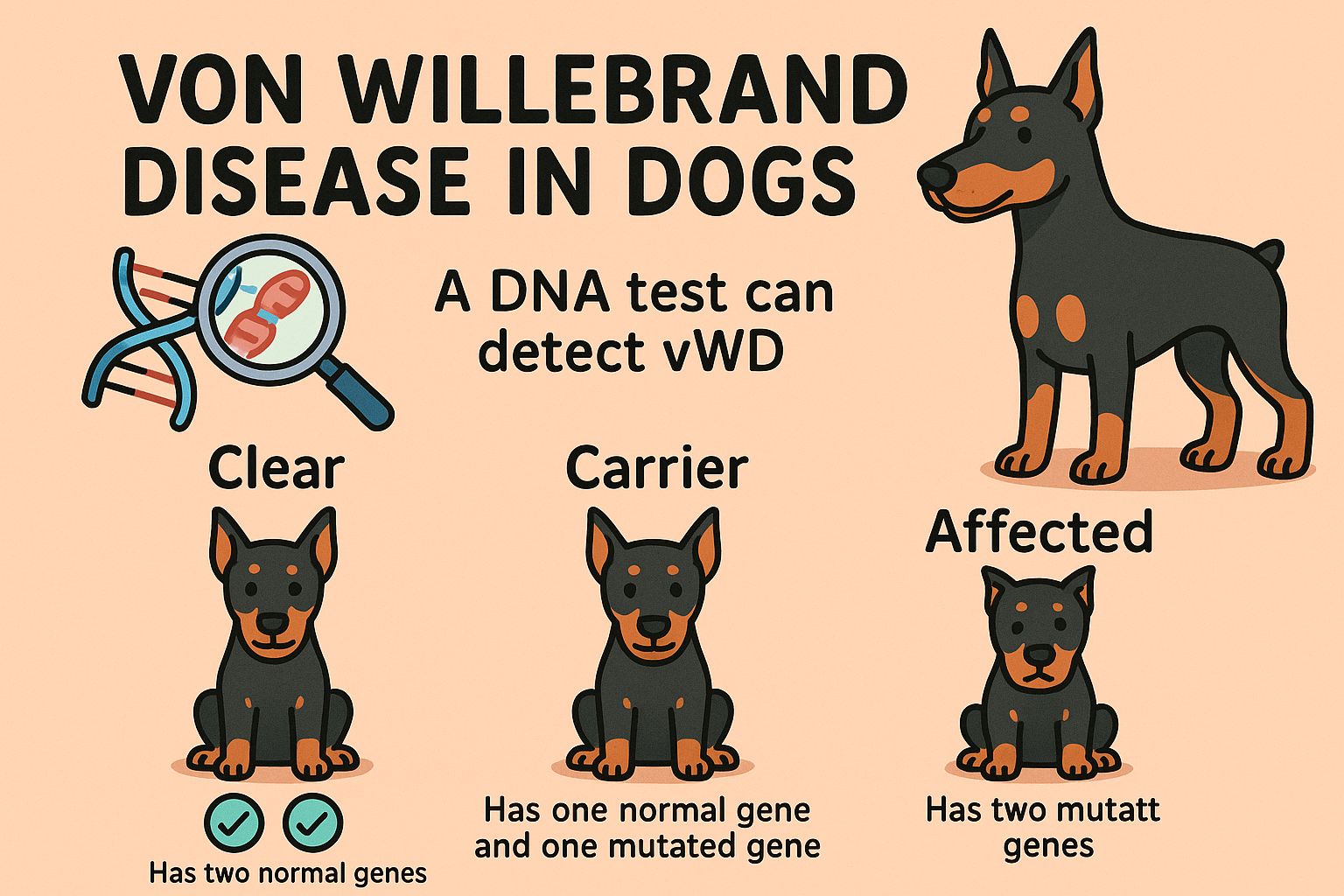
Von Willebrand Disease (vWD) is one of those genetic conditions that every responsible Doberman owner—and especially every responsible breeder—should be aware of. It’s often called the “canine version of hemophilia,” and while it doesn’t always show itself in dramatic ways, it can become life-threatening during surgeries, injuries, or even routine procedures like nail trims or dental work.
At Wonder Doberman, we take this disease very seriously. All of our breeding dogs are DNA tested, and we provide official proof of testing to our puppy buyers. In this post, we’ll explain what Von Willebrand Disease is, how to test for it affordably, why vets may ask for a DNA test before surgery, and how you can protect your dog from the consequences of this common—but preventable—genetic condition.
Table of Contents
What Is Von Willebrand Disease (vWD)?
Von Willebrand Disease is an inherited bleeding disorder caused by a deficiency or abnormality of a protein in the blood called von Willebrand factor (vWF). This protein helps platelets stick together and form clots to stop bleeding. Without enough of this factor, a dog’s blood cannot clot properly, which can lead to prolonged bleeding after injuries, surgeries, or even minor cuts.
There are three types of vWD in dogs:
- Type I – Partial deficiency of von Willebrand factor. This is the most common type and is found in Dobermans.
- Type II – Abnormal von Willebrand factor that doesn’t function properly.
- Type III – Complete absence of von Willebrand factor. This is the most severe and dangerous form, though it is rare and usually found in breeds like Scottish Terriers and Shetland Sheepdogs.
Dobermans are specifically at risk for Type I, which can range from mild to severe.
Symptoms of Von Willebrand Disease
Some dogs with vWD never show symptoms. Others may bleed excessively even from a routine spay or neuter. Common signs include:
- Nosebleeds (epistaxis)
- Prolonged bleeding after nail trims
- Bleeding gums or blood in the mouth
- Bloody stool or urine
- Excessive bleeding during or after surgery
- Bruising easily
- Prolonged heat cycles or postpartum bleeding in females
It’s important to note: many dogs go undiagnosed until something goes wrong, such as a surgery that won’t stop bleeding or an injury that won’t clot. That’s why knowing your dog’s genetic status before any procedure is vital.
Why Your Vet May Ask for a DNA Test
If you own a Doberman—or any breed prone to bleeding disorders—your veterinarian may ask for a DNA test before performing a surgery, especially if it’s an elective one like spaying/neutering, dental cleanings, lump removals, or even minor orthopedic procedures.
This isn’t your vet trying to upsell services; it’s because if your dog is affected by vWD and they don’t know it, your pet could bleed to death under anesthesia. There are special medications and blood products that can be used for dogs with vWD, but your vet has to plan for them in advance.
In Quebec, some vets may offer this DNA test directly—but the cost can be shocking.
The Cost of Testing in Quebec
Many of our clients in Quebec are surprised to hear that some veterinary clinics charge around $400 to test for just one variant of Von Willebrand Disease—Type I. While this is useful, it’s not always the most efficient way to go, especially if you’re interested in your dog’s broader health picture.
At Wonder Doberman, we believe there’s a better solution.
A Smarter, More Affordable Option: Canine HealthCheck
Instead of spending $400+ on one single test at the vet, we recommend doing a full panel DNA test yourself through a trusted company like Canine HealthCheck (recently re-branded as Orivet). This test is:
- Affordable (often under $200 USD, even with shipping to Canada)
- Comprehensive (covers around 320 different genetic conditions including all variants of vWD)
- Easy to use (simple cheek swab done at home)
- Trusted and recognized by most vets and breeders
When you test with Canine HealthCheck, you don’t just get the vWD Type I result—you get a full genetic profile of your dog. That includes other important breed-specific risks like dilated cardiomyopathy (DCM), hypothyroidism, eye disorders, degenerative myelopathy, and more.
Understanding the Results: Clear, Carrier, or Affected?
The DNA test results for Von Willebrand Disease Type I will show one of the following statuses:
1. Clear (Genetically Normal)
If your dog is clear for Von Willebrand Disease Type I, it means they do not carry any copies of the mutated vWD gene. Their genetic status is homozygous normal—meaning both copies of the gene are healthy and fully functional.
This result is significant for several reasons:
- Your dog will not develop the disease. Since they do not carry the mutation, their body will produce von Willebrand factor normally, allowing proper blood clotting and minimizing the risk of bleeding complications during injury or surgery.
- Your dog cannot pass the disease to offspring. Even if bred to a carrier or affected dog, a clear dog cannot contribute a mutated gene to the puppies. This is especially important in breeding decisions, as clear dogs offer the highest level of safety in preserving genetic health.
- No special precautions are needed for medical procedures. While every dog should still receive individualized veterinary care, a dog that is genetically clear does not require special medications, transfusions, or pre-surgical blood clotting evaluations due to vWD.
- Ideal for breeding programs. When a clear dog is bred to another clear dog, 100% of the puppies will also be clear. When bred to a carrier, no affected puppies can be born, although some may inherit the carrier status.
In short, a “clear” result is the gold standard. It means your dog is free of the disease, free of the gene, and free of the risk of passing it on. At Wonder Doberman, this is the result we aim for in our breeding program wherever possible, and all our puppy buyers receive documentation showing the vWD status of both parents to ensure peace of mind.
2. Carrier (Heterozygous / N/M)
A carrier has one normal copy and one mutated copy of the gene responsible for vWD. Their genetic result is heterozygous (N/M).
- Your dog is not sick, but they carry the mutation.
- They will not develop full-blown disease, because their one normal gene is usually enough to produce sufficient von Willebrand factor.
- Rare symptoms may occur in high-stress surgical scenarios, trauma, or when using medications that interfere with clotting. Most carriers live normal lives but should be noted in veterinary records.
- Can pass the gene to offspring: When bred, a carrier can transmit the mutated gene 50% of the time.
- If bred to another carrier, there is a:
- 25% chance of producing a clear puppy,
- 50% chance of producing a carrier puppy, and
- 25% chance of producing an affected puppy (with two mutated genes).
- If bred to another carrier, there is a:
- Should not be bred to another carrier: Responsible breeders either avoid breeding carriers entirely or ensure that they are only paired with a genetically clear mate to avoid producing affected offspring.
At Wonder Doberman, we never pair two carriers. If a carrier is kept in a breeding program due to exceptional qualities, we always match them with a clear partner and fully inform buyers of the genetic outcome.
3. Affected (Homozygous Mutated / M/M)
An affected dog has two mutated copies of the vWD gene. Their genotype is homozygous mutated (M/M). These dogs are considered clinically at risk for Von Willebrand Disease Type I.
- High risk for bleeding complications: Their body cannot produce sufficient von Willebrand factor, impairing the blood’s ability to clot properly.
- May bleed excessively from surgeries, tooth loss, cuts, spaying/neutering, nail trims, or trauma. Even rough play can sometimes lead to internal bruising or bleeding.
- Requires special veterinary care: Your vet should be informed before any medical procedure. In many cases, affected dogs are pre-treated with medications like desmopressin (DDAVP) or given blood products before and during surgery to help prevent hemorrhage.
- Will always pass on one copy of the mutated gene: If bred to a clear dog, 100% of the puppies will be carriers. If bred to another carrier, 50% of the puppies could be affected.
- Should never be bred: Responsible breeders do not use affected dogs in their programs to avoid producing more affected puppies and to reduce the prevalence of the disease in the breed population.
Affected dogs can live happy lives with careful management and an informed veterinary team. However, the condition is entirely preventable through DNA testing and responsible breeding. At Wonder Doberman, we work diligently to ensure that none of our puppies are ever born with this risk.
Why Responsible Breeders Avoid Producing Affected Puppies
It’s simple: affected dogs are at real risk of serious health problems, and the condition is 100% preventable through responsible breeding.
At Wonder Doberman:
- We test every breeding dog for vWD.
- We only pair dogs in ways that avoid producing affected puppies.
- We can provide proof of testing to every client, including the full DNA report for both parents.
This means our puppies cannot be affected by Von Willebrand Disease Type I. You can show these documents to your veterinarian to avoid unnecessary testing or concerns before surgeries or other procedures.
How to Talk to Your Vet About It
If your vet asks for a vWD test before surgery, you can confidently say:
“My Doberman comes from a breeder who tests for this disease. Both parents were tested and are clear or carrier only. I have the proof if you’d like to review it.”
If your vet still insists on a test, you can choose to have it done through your own kit from Canine HealthCheck or any other reliable lab. Don’t feel pressured into a $400+ clinic fee when you can get ten times the information for half the price.
What Happens if a Dog Is Affected?
If your Doberman (or other breed) is affected, don’t panic. With proper knowledge and care, affected dogs can still live long, happy lives. However, it’s important to:
- Avoid unnecessary surgeries or trauma
- Alert all veterinarians and groomers to your dog’s condition
- Request special care like desmopressin (DDAVP) before procedures
- Avoid medications that interfere with clotting, like aspirin or NSAIDs
- Consider medical ID tags so emergency responders are aware
Being affected does require lifestyle adjustments—but it’s not a death sentence. That said, no dog should be born affected when we have the tools to prevent it.
Summary: What You Should Do
Here’s a checklist to help you navigate Von Willebrand Disease as a Doberman owner:
Ask your breeder for DNA proof of vWD status in both parents
If you didn’t receive this proof, test your dog yourself with Canine HealthCheck
Avoid paying $400+ at the vet for a single test
Always inform your vet of your dog’s vWD status before any procedure
Never breed two carriers together—work only with breeders who test
Keep digital and printed copies of all results for your records and vet visits
Why Wonder Doberman Is Different
At Wonder Doberman, health is not a guessing game. We don’t cut corners or take chances. Every one of our breeding dogs is fully tested, and we never breed without reviewing the full genetic picture.
Here’s what you can expect from us:
- Full transparency with health records
- No affected puppies—guaranteed by DNA proof
- Open education about what these conditions mean
- Support for you and your vet if you ever need to show health proof for surgery
We believe in building trust—not just selling puppies. And part of that trust means doing everything we can to ensure our dogs are healthy, happy, and safe in the hands of their loving families.
Final Thoughts
Von Willebrand Disease is real. It’s serious. But it’s also 100% preventable with responsible breeding and accessible DNA testing.
If you’re a Doberman owner, educate yourself, ask questions, and demand proof. And if you’re a future owner looking for a breeder—make sure they’re doing their part.
Your dog’s health—and maybe even their life—depends on it.