
How Genetics Shape Temperament in Dogs (with Doberman-Savvy Insights)
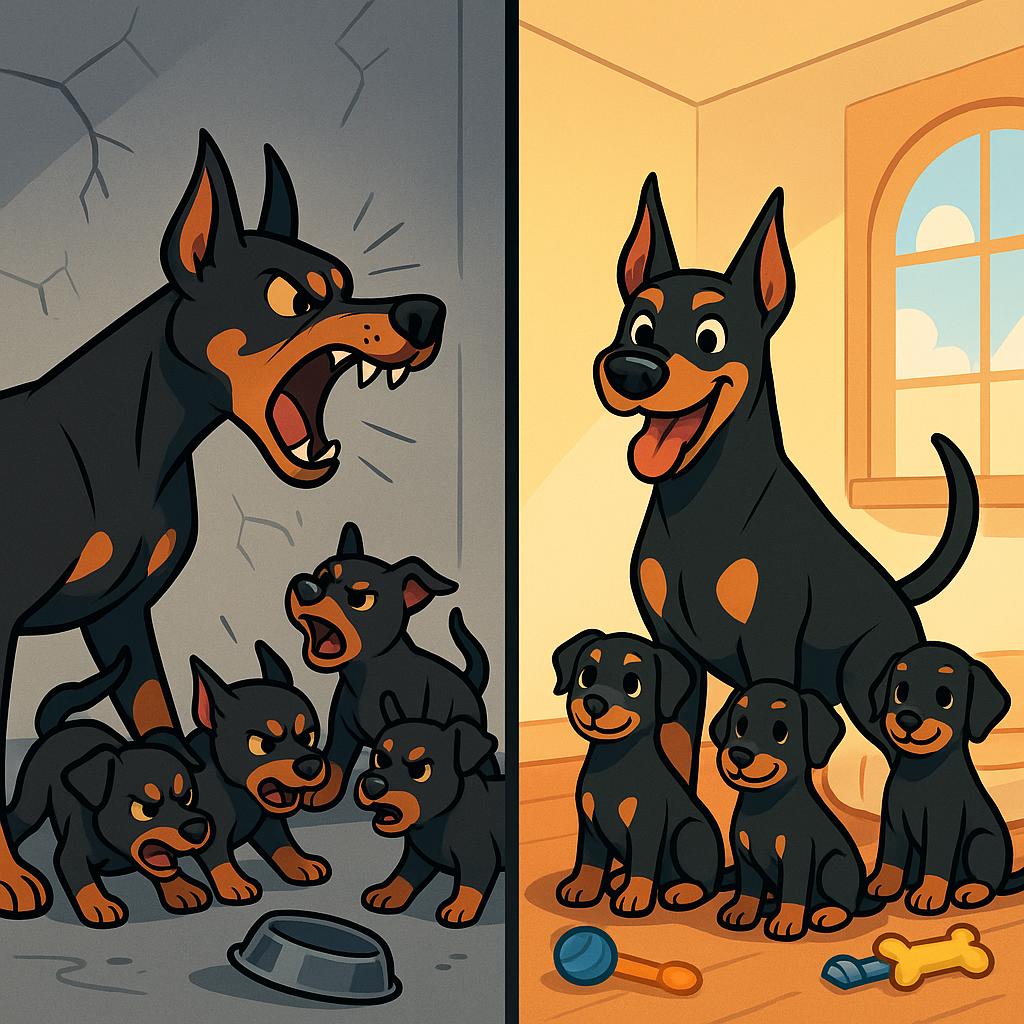
Ask ten dog people to define “temperament” and you’ll get twenty answers. For our purposes, temperament is the predictable, inherited baseline of how a dog perceives, processes, and responds to the world. It’s the dog’s default operating system: its emotional reactivity, recovery speed after stress, sociability, confidence, drive, resilience, and impulse control – before training and life experience layer on new behaviors.
Environment can polish (or corrode) what genetics provide, but it cannot fundamentally rewrite it. When you see a Doberman with iron nerves, a clear head, and high trainability, you’re looking at multigenerational selection—not luck, and not just “a lot of socialization.” Conversely, when you see chronic skittishness, hair-trigger reactivity, or a dog who melts under pressure, you’re often seeing heritable shortcomings compounded by gaps in upbringing.
This article unpacks how genetics and temperament in dogs are connected, what breeders can and should do about it, how owners can select wisely, and how training interfaces with the dog’s inherited architecture. We’ll use Dobermans frequently as examples, while keeping the content useful for all breeds.
Table of Contents
Temperament Isn’t an Accident
Temperament isn’t a single slider. It’s a cluster of traits that travel together and can be selected for:
- Nerve strength (stress resilience): How stable is the dog under novel stimuli—noise, surfaces, crowds, pressure?
- Startle and recovery: Every dog can startle. Good temperament shows in fast, complete recovery without baggage.
- Environmental soundness: Comfort with footing, slick floors, stairs, busy spaces, vehicles, ringside chaos.
- Social confidence: Easy neutrality around people and dogs; discernment without generic fear or indiscriminate friendliness.
- Drives: Prey, food, play, rank/social; how cleanly they’re expressed and how accessible they are to the handler.
- Biddability & trainability: Desire to work with the person; responsiveness to feedback; problem-solving without spiraling.
- Impulse control: The ability to hold it together when excited or stressed.
- Aggression thresholds and quality: Not “how much,” but how—is it purposeful, controllable, and appropriate, or chaotic?
- Recovery after correction: Does the dog crumble or stay engaged and learn?
These traits have genetic underpinnings. You can improve them through selection, you can preserve them through wise pairings, and you can spoil them through poor breeding choices. You can’t conjure them from nothing through “more training.”
Genetics 101 for Temperament
Polygenic Traits and Heritability
Temperament is polygenic—influenced by many genes, each with small effects. You’ll often see family temperaments: lines that run confident, civil, and clear, versus lines that tend toward flightiness or sharpness. In quantitative genetics, we talk about heritability (h²)—the proportion of trait variation attributable to genetics in a given population and environment. For behavior, many subtraits fall roughly in the moderate range (often ~0.2–0.4), which is high enough to make selection work but low enough that environment still matters.
Gene–Environment Interactions
Two littermates may inherit similar “settings” but diverge based on early experiences—good or bad. Genetics sets the range and defaults; environment selects which parts of the range get exercised. This is why predictable husbandry and structured, balanced training are powerful—they express and strengthen the dog’s best inherited options.
Epigenetics and Parental Effects
Stress, nutrition, and inflammation in parents (particularly the dam) can tweak how genes are expressed in puppies. Maternal behavior: calm, confident dams versus anxious, frantic dams – also leaves marks on puppy stress systems. These are biologically mediated influences, not just “learned” behaviors.
Genetics and Temperament in Dogs: What the Science (and Centuries of Breeding) Already Proves
You don’t need a genome browser to see that temperament is heritable—purpose-bred dogs prove it. Livestock guardians, protection breeds, scent hounds, retrievers, herding breeds: each was sculpted for behavior first. Guide and service dog programs use data-driven selection because it works; they retire lines that repeatedly fail for environmental soundness or impulse control.
Key practical points that repeatedly replicate across programs and breeds:
- Temperament has line signatures. Reputable breeders can tell you, with eerie accuracy, how a puppy from specific lines will mature.
- Selection beats “rehabilitation.” Programs that keep breeding “projects” because they’re pretty or fashionable bleed performance and stability within a few generations.
- Inbreeding reveals and concentrates behavior—good and bad. Linebreeding fixes type and temperament only if you’re doubling up on quality.
Breed-Level Differences and the Doberman Example
Dobermans were developed for courageous, obedient, people-attached guard work with clarity and discernment. Within the breed today you’ll find subpopulations shaped by different priorities:
- European working and conformation lines that still place heavy weight on working character, testability, and transparency.
- American show lines with decades of ring selection; some carry excellent stability and biddability, others have drifted toward either softness or over-sensitivity if temperament wasn’t a top priority.
At Wonder Doberman, we’re explicit about balancing the best of both worlds. We favor European standards and testing culture and typically plan for 50–100% European blood in breedings, while recognizing that select American dogs can contribute desirable clarity, elegance, and teamwork when chosen carefully. We avoid pushing puppies toward “too American” extremes, and we remain disciplined about nerve strength and workability as first-order traits. That balance is genetic stewardship, not marketing.
What a Pedigree Really Tells You About Temperament
A pedigree isn’t just names and titles—it’s a temperament roadmap if you know how to read it.
- Line consistency: Multiple relatives with similar, desirable character is more predictive than one famous dog.
- Depth of information: Videos, trial critiques, show critiques that mention “excellent nerve,” “stands firm,” “full grips,” “clean recovery,” “sound, confident” matter.
- Health transparency: Dogs with clear heads are often bred by people who are transparent about health and testing too—both derive from disciplined selection.
- COI (Coefficient of Inbreeding): Excessive COI increases risk of inbreeding depression, which can show up as lower stress tolerance, poor recovery, and general fragility. We are cautious with COI—consistently above ~6% warrants scrutiny—and we avoid stacking related weaknesses.
- Sibling and progeny data: Littermates and progeny reveal hidden recessives—fearfulness, noise sensitivity, weak recovery—even if a single dog looks good.
Bottom line: Temperament is a population property. You’re buying a family, not a unicorn.
Myths That Derail Good Temperament
“Any puppy can be confident with enough socialization.”
Socialization exposes what genetics provide; it doesn’t manufacture nerve strength.
“He’s skittish because he wasn’t socialized.”
Maybe. But if multiple relatives are skittish, that’s not a coincidence.
“Titles prove temperament.”
Titles can reflect good temperament, but they can also be earned under management that masks issues. You must evaluate the quality of performance and the context.
“One gentle parent fixes a sharp parent.”
Temperament is polygenic. You’re mixing decks, not averaging two numbers.
“Behavior DNA tests can select temperament.”
Single-marker “behavior panels” are not reliable selectors for complex traits like nerve, biddability, or environmental soundness.
Color, Health, and Behavior: Untangling the Wires
Some coat color genes co-travel with health risks (e.g., dilution and coat issues in some lines), but there’s no deterministic “color = temperament” rule. What looks like a “color temperament” is usually line temperament—families where color and character happen to be correlated because of how they were bred. Select for character first, then for the rest.
A note on the Z-Factor (albino lineage in Dobermans)
You’ll sometimes hear breeders or buyers mention the “Z-factor.” In AKC paperwork, the “Z” code is used to track Dobermans that descend from the original albino (“white”) line. These dogs aren’t simply a rare color; they carry a form of albinism that reduces pigment in the skin and eyes.
Why this matters:
- Health & welfare risks: Reduced pigment is linked with photosensitivity, sunburn, and higher skin cancer risk, along with ocular issues (light sensitivity/glare and reduced visual comfort).
- Behavior knock-on effects: Albinism itself isn’t a “temperament gene,” but vision discomfort and chronic light sensitivity can affect coping—some dogs may show startle, avoidance, or irritability in bright, busy environments because they’re uncomfortable seeing in glare. That’s not “protectiveness”; it’s a welfare issue.
- Registry nuance: AKC marks this lineage with a “Z” to flag albino ancestry. Other registries may not label it as clearly, so ask for documentation and confirmation that breeding stock is not Z-factored.
Our stance is simple: select for character and health first, and avoid Z-factored breedings. If a pedigree shows Z ancestry (or a breeder can’t clearly rule it out), pass—there are plenty of well-bred, fully pigmented Dobermans with the nerve, clarity, and biddability you want.
Buyer tip: When reviewing a pedigree, ask directly:
- “Is this dog or its parents Z-factored or carrying albino lineage?”
- “Can you show registration/health documentation confirming no Z ancestry?”
Remember, “color ≠ temperament.” What looks like a “color temperament” is almost always line temperament—families where color and character became correlated through how they were bred. The Z-factor is different: it flags a pigment disorder with real health implications that can indirectly complicate behavior. Choose lines bred for sound nerves, full pigment, and transparency.
The Early-Life Bridge: How Biology Meets Upbringing
Genetics loads the dice; early life throws them.
- Gestation: Maternal stress hormones and inflammation can affect puppy stress systems. Calm, secure dams produce calmer puppies on average.
- Perinatal care: Temperature, nutrition, and low-stress whelping matter; chaos imprints chaos.
- ENS/Early handling: Thoughtful early stimulation can prime resilience—but it’s not a cure for bad genes.
- Critical periods (3–16 weeks): Puppies need structured, positive exposure to normal life with rest, predictability, and boundaries. Flooding and free-for-all chaos are as harmful as deprivation.
- Weaning to placement: Noise, surfaces, travel, crate nap practice, calm separation, polite engagement—all built on calm dams and stable routines.
A note on balanced training, which we practice and advocate: reward helps behaviors grow; fair, thoughtful consequences provide clarity and impulse control. Balanced training expresses genetic stability—never replaces it.
Practical Selection: How Breeders Protect Temperament
1) Define temperament targets in writing.
Not just “stable.” Spell out: nerve strength, recovery, social neutrality, environmental confidence, drive access, biddability.
2) Demand evidence.
Videos under distraction; trial critiques; crowded show environments; busy parking lots; dogs being handled by strangers; how they recover after a startle; how they take a fair correction.
3) Select across a family, not a star.
Good sires and dams come from good siblings and produce good siblings.
4) Use linebreeding conservatively and intentionally.
Double up on what you want, not on what you tolerate. Watch COI; we pay attention when it creeps up and avoid reinforcing known weaknesses. At Wonder Doberman, all our dogs have less than 1% COI.
5) Don’t excuse weak temperament because a dog “looks” the part.
Flair without a foundation is a house of cards. Breeding for head shape but not head use is how breeds lose themselves.
6) Track data.
Keep placement notes, owner feedback, test results, stress points, startle recoveries, sensitivities, and how dogs mature. This becomes your temperament map for each line.
7) Pairings are equations.
Think: Which strengths cover which weaknesses? If both sides carry noise sensitivity or slow recovery, you’re compounding the risk.
Litter Evaluation: What We Look For (and How Owners Can See It Too)
We evaluate puppies repeatedly at different arousal levels and contexts—not just a single test day.
- Baseline composure: Heart-rate in behavior terms—are they thoughtful or twitchy?
- Novelty approach: Do they investigate new objects with curiosity?
- Startle & bounce-back: Clap, drop a soft item, change the environment—do they quickly reset?
- Human handling: Mouth exams, feet, ears, gentle restraint—do they accept and recover?
- Social neutrality: Are they pushy, clingy, or nicely balanced?
- Work samples: Food games, simple puzzles, toy engagement—shows problem-solving and frustration tolerance.
We then match puppies to homes by function and family reality, not by color or collar.
Owner’s Guide: Matching Your Home to a Genetic Package
1) Choose the breeder first, then the puppy.
You’re shopping for a temperament program, not just a pet.
2) Ask about temperament like a pro:
- What traits do you select for and against?
- What did you keep or cull in the last generation and why?
- How do your dogs behave in crowds, hotels, elevators, veterinary clinics?
- What are the common temperament pitfalls you see in your line—and how are you addressing them?
3) Believe patterns, not promises.
If multiple relatives carry a trait, expect it to reappear.
4) Be honest about your bandwidth.
High-drive puppies without structure turn into frustrated adults. Choose clarity and biddability over raw horsepower if your life is busy.
5) Plan the first six months.
Predictable routine, balanced training, boundaries, thoughtful socialization, and plenty of calm—not nonstop stimulation.
Case Studies from the Whelping Box (Composite Examples)
Case 1: The Glittering Outcross
Two excellent individuals from dissimilar lines produce a big, handsome litter. Half the puppies are brilliant… the other half carry unexpected sensitivity to sudden noise. Why? Outcrossing reshuffled polygenes and unmasked weaknesses not evident in either parent alone. Lesson: evaluate the whole litter and adjust future pairings accordingly.
Case 2: The Linebred “Clone” Litter
A conservative linebreeding on a dam with outstanding nerve yields high uniformity: solid recoveries, easy trainability, and moderate drives. One puppy shows softness. Lesson: linebreeding concentrates averages; there’s still variance, but your “hit rate” improves when you double up on excellence.
Case 3: Great Genes, Botched Rearing
A promising puppy placed into chaos—no routine, no structure, constant “socialization” without rest, and zero boundaries—develops frantic reactivity. When moved to a structured, balanced home, reactivity decreases, but the stress imprint lingers. Lesson: Genetics give capacity; management decides whether you access or abuse it.
Training Meets Genetics: Why Balanced Clarity Works
Reward marks and grows the behaviors you want, and information-rich corrections (fair, brief, unemotional) set boundaries that prevent spirals into bad choices.
Dogs with good nerve accept guidance, adjust, and stay in the game. Dogs with thin nerve crumble or escalate. That response is largely heritable.
Balanced training isn’t “harsh”; it’s complete. It gives stable dogs the road map they’re genetically primed to follow.
Health, Hormones, and the Temperament Picture
Pain and discomfort (hips, elbows, spine, skin) can mimic temperament problems. We screen extensively; healthy bodies support healthy behavior.
Endocrine issues (thyroid, reproductive hormones) can color mood, reactivity, and energy. Genetics influence susceptibility here, too.
Neurologic clarity is non-negotiable: we don’t excuse chronic anxiety or volatility as “quirky.” If it’s in the family, we avoid it.
What Breeders Should Document (and Share)
- Temperament criteria for selection and culling.
- COI targets and how you keep them in check; why you accept or reject certain levels.
- Relatives’ behavior—both keeps and pet placements—over time.
- Contextual test notes: not just “passed,” but how, under what pressure, with what recovery.
Transparency makes lines predictable; predictability is kindness.
Owner Red Flags When Evaluating a Breeder
“Temperament is all training.” (It isn’t.)
“We don’t track COI or family behavior; our dogs are sweet.” (That’s not a program.)
No videos of adults in real-world chaos; only posed photos.
Excuses for reactive or fearful adults: “He’s just protective.” (Protection is controlled courage, not panic.)
Pairings justified by color, trend, or convenience rather than temperament complementarity.
Our Breeding Philosophy at Wonder Doberman
Function first: Courage, clarity, environmental soundness, biddability.
Balanced blood: We prefer European standards and testing culture and typically aim for 50–100% European in pairings, while selectively incorporating American contributions that improve balance. We explicitly avoid pushing puppies toward overly “American” extremes in temperament.
COI discipline: We maintain ultra-low COI across our program: every breeding dog is <1% COI, and our litters are planned to be at or near zero COI. That isn’t “random outcrossing” – it’s disciplined selection for nerve strength, clarity, biddability, and health while safeguarding genetic diversity. When a potential pairing nudges COI upward, we redesign it. Low COI supports long-term vigor, fertility, and stress resilience, while temperament and type are secured by consistent, multi-generation selection and real-world testing (not by stacking close relatives).
How we apply it: we verify pedigree COI with reputable calculators, check relatedness on both sides of the pedigree, and prioritize families that repeatedly show stable nerves, fast recovery, and clean work. Diversity is our safety net; character is our compass.
Data, not stories: We keep notes on startle/recovery, social neutrality, stress points, and maturity arcs—across parents, siblings, and progeny.
Balanced training from day one: Clear routines, thoughtful exposure, reward-rich learning, and fair boundaries so innate stability is expressed, not squandered.
Closing Thoughts: Protecting Temperament Is a Choice, Not a Mystery
Temperament is heritable enough that disciplined selection moves the needle—fast. It’s also plastic enough that good husbandry and balanced training can reveal the best your dog already carries. When breeders treat temperament as a first-order trait (right alongside health and structure), they produce predictable, resilient dogs who thrive in real life, not just in photos.
At Wonder Doberman, we don’t gamble with nerve or clarity. We breed, raise, and train with temperament as the compass, favoring European rigor and strategic balance, so that the dog you bring home has the genetics to stand firm, think clearly, learn eagerly, and live confidently in your world. That isn’t luck. It’s stewardship.