
Dog’s Pedigree Explained: Why It Matters More Than You Think
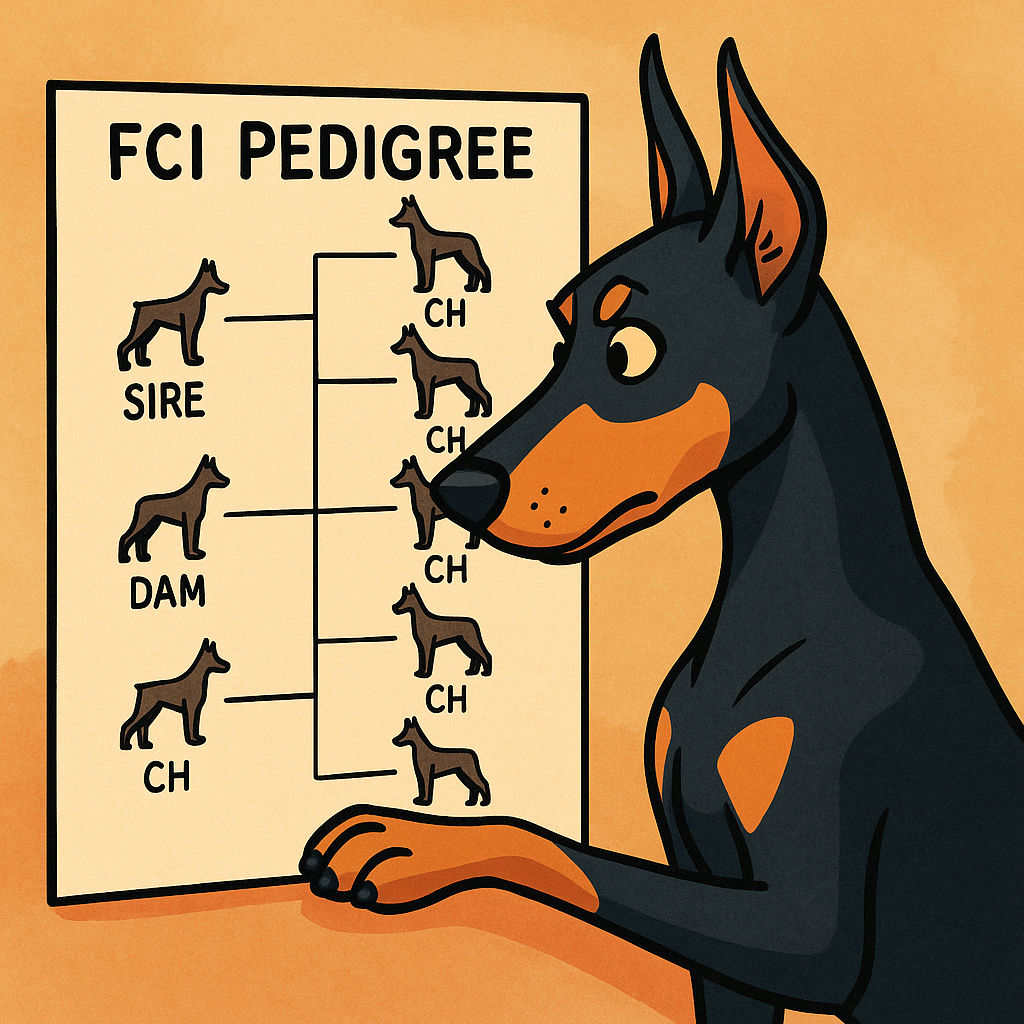
When looking for a new dog, especially a purebred Doberman, it’s common to focus on appearance, titles, or personality of the parents. But there’s something even more important that often goes overlooked: the pedigree.
A dog’s pedigree is much more than a family tree. It’s a map of your future dog’s health, temperament, structure, and genetic potential. It can also be a warning sign. At Wonder Doberman, we take pedigree analysis seriously, because we believe in doing what’s right for the breed, not just what looks good on paper.
Table of Contents
What Is a Dog’s Pedigree?
A dog’s pedigree is a documented lineage chart showing its ancestors. Usually, it includes three to five generations and lists names, registration numbers, titles, and sometimes health certifications.
Each name on the pedigree represents not only a dog, but a potential influence on your puppy’s traits—both good and bad.
Common Elements in a Pedigree:
- Dog’s name and kennel prefix
- Titles and working achievements (e.g., IPO, ZTP, CH, OB, CGC)
- Health certifications (e.g., OFA, vWD, DCM1/DCM2 results)
- Date of birth
- Color and markings
- Country of origin or registry
Learning how to interpret these details gives you insight into:
- Temperament and working drive
- Health risks and genetic predispositions
- Structural strengths or faults
- Breeding ethics and philosophy behind the dog
One important distinction that often confuses people is the difference between CKC (Canadian Kennel Club) and FCI (Fédération Cynologique Internationale) pedigrees. FCI pedigrees are much more comprehensive—they recognize and include titles from all affiliated countries, meaning that if a dog is an International Champion or has earned titles in multiple European nations, those achievements are clearly listed. In contrast, the CKC only acknowledges titles earned within its own registry. That means even if a dog comes from a long line of prestigious international champions, none of those titles will appear on a CKC pedigree.
For example, our girls Hydra and Athena have exceptional bloodlines filled with high-level international champions across several European countries. Yet, on their CKC papers, none of that is visible: no “CH” titles are listed. We remember hearing someone at a show ring comment about Scylla, Hydra’s daughter: “She does look nice for a dog without any champion parents.” If only they knew how many truly elite, **FCI-recognized champions, far more demanding than a CKC CH title, **stand behind her! This is why understanding the full international pedigree is so important, and why we at Wonder Doberman always look far beyond the surface.
Why It’s Not Just About Titles
Many people glance at a dog’s pedigree and get excited by the presence of champions. While titles can indicate quality, they are only one part of the puzzle.
Let’s say both parents are champions. Great, right? Maybe. But what if both parents also share the same great-grandfather? And what if that great-grandfather passed on a predisposition for heart disease?
That’s why understanding the depth of the pedigree matters.
Inbreeding, Linebreeding & the Coefficient of Consanguinity
The coefficient of consanguinity (also known as the inbreeding coefficient) is a measure of how closely related the parents of a dog are. It’s expressed as a percentage.
Interpreting the Coefficient:
- 0% = No known shared ancestry within the pedigree (ideal)
- Under 2% = Very low risk of inherited genetic problems
- 2–6% = Considered a “breeder’s zone” with some strategic value, but care is needed
- Over 6% = Elevated risk of health and behavioral issues
- Over 12.5% = Equivalent to mating half-siblings
- Over 25% = Equivalent to parent/offspring or full sibling mating
Unfortunately, in the Doberman world, it’s common to see pedigrees with over 40% consanguinity. Yes, you read that right—over 40%. And it’s not rare.
This level of inbreeding contributes to the decline of the breed. We’re seeing:
- Higher rates of DCM (Dilated Cardiomyopathy)
- Shorter lifespans
- Autoimmune disorders
- Behavioral instability
- Weak immune systems
Why Is This Happening?
Some breeders are stuck in a cycle of “popular sire syndrome” – overusing the same champion dogs again and again in hopes of reproducing a winning look. Others are intentionally linebreeding (a form of controlled inbreeding) to lock in traits. But when this is repeated across generations, it becomes dangerous.
At Wonder Doberman, we work hard to break that cycle. We proudly breed dogs with coefficients as low as 0%, which is almost unheard of in North America but more achievable with carefully selected European lines.
What Is the Z-Factor in Dobermans?
One of the biggest red flags in Doberman pedigrees is the Z-Factor, which refers to albino Dobermans and their descendants.
Albino (or “white”) Dobermans stem from a genetic mutation that causes albinism. These dogs are not simply cream-colored or unique—they carry significant genetic defects.
Albino-Linked Risks:
- Skin cancer
- Light sensitivity and vision issues
- Temperamental instability
- Immune system dysfunction
- Overall fragility and short lifespans
The American Kennel Club flags dogs with Z-Factor ancestry. A “Z” is added to their registration numbers, which makes it easy to identify.
Unfortunately, many breeders either ignore this, lie about it, or simply don’t know.
At Wonder Doberman, we absolutely avoid any Z-Factor dogs. We believe health and sound genetics come first, always.
European Pedigrees vs North American Pedigrees
One of the most striking differences in the dog’s pedigree quality comes down to where the dog is bred.
In North America:
- A dog can earn a conformation title based on appearance alone
- Judges are not required to explain their choices
- No temperament testing is required before entering a show
- The same dogs can win or lose multiple times in the same weekend, depending on the judge’s preference
- No consistent standard is enforced
In Europe:
- Dogs are tested for temperament first (by a behaviorist)
- Then they undergo a vet inspection before entering the ring
- Judges are required to provide written critiques of every dog
- Titles hold more weight due to stricter entry standards
- Working ability and health are often prioritized alongside appearance
Because of these differences, a European Champion typically means a lot more than a North American one.
At Wonder Doberman, many of our dogs have multinational pedigrees from top European lines. These include not just beautiful conformation but also health-tested, mentally sound, working-capable dogs.
Did you know that in Europe, every dog entering the show ring must be identified by microchip or tattoo before being allowed to compete? No ID, no entry, period. This ensures that the dog being judged is exactly who the paperwork says it is. Unfortunately, in Canada and the U.S., there is no such verification process.
We’ve experienced this firsthand: during one show, our handler accidentally swapped our dog’s entry number with that of her friend, who was also showing a female Doberman. As a result, the wrong dog received the points. This kind of error should never happen, but it did, because there was no microchip scan to confirm identity. The situation created unnecessary drama, stress, and even threats from people who didn’t understand what had happened. Although the issue was eventually resolved, it was a difficult and emotionally exhausting ordeal. We even had to block a few individuals who unfairly targeted us over a simple and preventable mistake.
In Europe, this would never have happened. The strict identification protocols protect everyone involved, and that level of accountability is something we truly admire and wish to see adopted here in North America.
What to Look for in a Good Pedigree
When evaluating a dog’s pedigree, don’t just look at titles. Ask the deeper questions:
- What is the inbreeding coefficient?
- Are there any Z-Factor dogs in the lineage?
- Are there multiple dogs repeated in the pedigree?
- What kind of health testing has been done in the line?
- Are the dogs titled in working sports (IPO, IGP, etc) or only conformation?
- Does the lineage have a reputation for longevity and stable temperament?
- Where are the ancestors from? (Europe? North America? Russia? Spain? Germany?)
We encourage you to trace a pedigree back at least five generations. Patterns will start to emerge. Are the same dogs appearing over and over? Are there any red flags?
Why Seeing the Parents Isn’t Enough
Many buyers rely on seeing or meeting the sire and dam (mom and dad) to make a decision. While it’s helpful to meet the parents, it doesn’t tell the full story.
Let’s say the sire is calm, confident, and healthy. Great. But what if his grandfather died of DCM at age 4? Or his great-grandmother had chronic allergies and produced unstable puppies?
That information won’t be visible to the naked eye—but it will be hiding in the pedigree.
Dog’s pedigree does not lie. And once you learn how to read them, they become one of your most powerful tools as a future dog owner or breeder.
In Europe, it’s very difficult to cheat when it comes to registering dogs. The rules are strict, and in many cases, DNA testing is required to confirm that the puppies are truly the offspring of the registered parents. Unfortunately, in Canada and the United States, the system is much easier to manipulate. Some breeders exploit this by using the registration papers of an infertile female to falsely register litters from an unregistered one, boosting profits while deceiving buyers. It’s more common than many people realize. That’s why we strongly believe DNA verification of parentage should be mandatory.
The AKC has started to offer it as an option to promote ethical breeding, but it is still not required. The CKC has not yet implemented such measures. Hopefully, one day, both registries will adopt stricter standards to help protect buyers and eliminate unethical backyard breeding practices.
What Makes a Wonder Doberman Pedigree Different
At Wonder Doberman, we don’t just care about pedigrees—we study them, test them, and build them with purpose. Our philosophy is rooted in ethical breeding practices and a commitment to improving the Doberman breed for generations to come.
Our Standards:
- 0% to 2% consanguinity, wherever possible
- No Z-Factor or albino heritage
- Multinational European bloodlines
- Titles in both conformation and working
- Mandatory health testing
- Excellent longevity and temperament in the lines
- Early socialization and desensitization from birth
We choose partners for our breeding program based not on trends or marketing hype, but on solid, ethical foundations. The result? Confident, healthy Dobermans with true working drive and family stability.
Final Thoughts
Understanding dog’s pedigree is one of the most important skills a responsible dog owner or breeder can have. Whether you’re buying a puppy, adopting an adult, or planning a breeding, knowing how to read a pedigree will protect you, your dog, and the future of the breed.
Dobermans are a powerful, loyal, intelligent breed, but they are also fragile in the wrong hands. The breed is at a tipping point, and the only way forward is through education, ethics, and responsibility.
At Wonder Doberman, we’re proud to lead by example.
If you’d like to learn more about one of our dogs or how to evaluate a dog’s pedigree yourself, don’t hesitate to reach out. We believe that the more informed you are, the better your dog’s life will be.