
Understanding COI in Dogs – Why the Coefficient of Inbreeding Matters More Than You Think
When it comes to preserving the health, vitality, and future of any dog breed, the Coefficient of Inbreeding (COI) is one of the most important – and most overlooked – tools a breeder and owner can understand. For the Doberman breed, this number is not just a statistic; it’s a survival alarm.
Today, the sad truth is that the Doberman is on a slow decline, and excessive inbreeding is one of the biggest culprits. In fact, many American Dobermans now have a COI so high it’s beyond what would ever occur in nature – and the results are devastating for the breed’s health and longevity.
Table of Contents
What is COI?
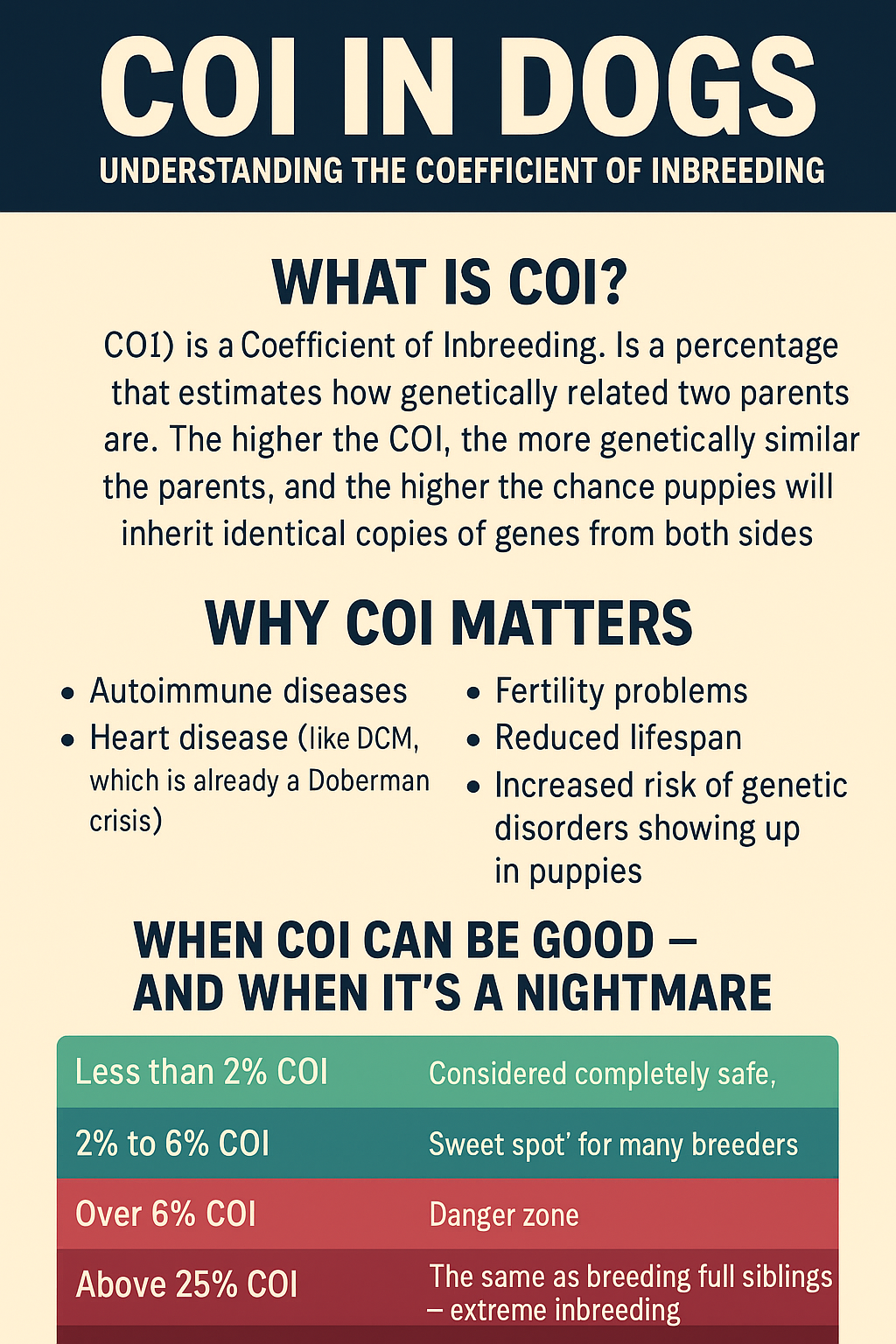
COI in dogs stands for Coefficient of Inbreeding. It is a percentage that estimates how genetically related two parents are. The higher the COI, the more genetically similar the parents – and the higher the chance their puppies will inherit identical copies of genes from both sides of the family tree.
- A 0% COI means the dog’s parents are completely unrelated in the known pedigree.
- A 100% COI would mean the dog is genetically identical to itself (impossible outside cloning, but high numbers mean extreme inbreeding).
The COI is usually calculated over a set number of generations (often 5, 10, or even the full pedigree if available).
Why COI in Dogs Matters
When the COI is high, you’re doubling up on genes – and while that can help “set” desirable traits like looks or temperament, it also sets the bad ones. That’s where trouble begins.
High COI = High Risk of:
- Autoimmune diseases
- Heart disease (like DCM, which is already a Doberman crisis)
- Fertility problems
- Reduced lifespan
- Increased risk of genetic disorders showing up in puppies
When COI Can Be Good – and When It’s a Nightmare
Some breeders argue that a small amount of inbreeding can help keep breed type consistent, especially in physical appearance and working ability. They are not wrong – if done carefully and kept in moderation.
- Less than 2% COI → Considered completely safe, with no measurable negative impact. The dogs are not closely related enough to worry about inbreeding depression.
- 2% to 6% COI → The “sweet spot” for many breeders. There are pros and cons, but when managed carefully, the positives (predictability, consistency) outweigh the negatives.
- Over 6% COI → Danger zone. The genetic diversity starts dropping quickly, and health risks begin to snowball.
- Above 25% COI → This is the same as breeding full siblings – extreme inbreeding.
- 40%+ COI → Catastrophic for genetic health. The breed loses resilience to disease and reproductive viability plummets.
Unfortunately, the majority of American-bred Dobermans now have COI over 40%, with many reaching 50–60%. This means the average American Doberman today is more inbred than the offspring of full siblings – something that would almost never happen in nature.
Detailed COI Examples With Pedigree Illustrations
1. Two Completely Unrelated Dogs → COI = 0%
Explanation:
Both parents share no common ancestors within the pedigree being analyzed (e.g., over 10 generations). All genetic material comes from unique, unrelated lines.
Check our dedicated post on how to read the dog’s pedigree here
Pedigree Example: Sire: Dog A
|
Puppy -----------
|
Dam: Dog B
Generations:
Dog A’s side: Dog A1 – Dog A2 – Dog A3 …
Dog B’s side: Dog B1 – Dog B2 – Dog B3 …
(No shared names between A-line and B-line)
2. Half-Sibling Breeding → COI ≈ 12.5%
Explanation:
The sire and dam share one parent in common. Half of the genetic material from that parent is doubled in the offspring.
Pedigree Example: Sire: Dog A
|
Puppy -----------
|
Dam: Dog C
Generations:
Dog A: (Father = Dog X, Mother = Dog Y)
Dog C: (Father = Dog X, Mother = Dog Z)
Here, Dog X appears once as the father of the sire and once as the father of the dam. This shared ancestor causes the COI to rise to ~12.5%.
3. Full Sibling Breeding → COI ≈ 25%
Explanation:
The sire and dam are full siblings (same father and mother). This means both sides of the pedigree are identical.
Pedigree Example: Sire: Dog A
|
Puppy -----------
|
Dam: Dog B
Generations:
Dog A: (Father = Dog X, Mother = Dog Y)
Dog B: (Father = Dog X, Mother = Dog Y)
Here, Dog X and Dog Y appear twice in the 1st generation of the pedigree — doubling all their genetic contribution.
4. Grandparent × Grandchild → COI ≈ 25%
Explanation:
One parent is also a grandparent of the other. This creates an intense genetic concentration of the grandparent’s genes.
Pedigree Example: Sire: Dog A
|
Puppy -----------
|
Dam: Dog C
Generations:
Dog A: (Father = Dog X, Mother = Dog Y)
Dog C: (Father = Dog A, Mother = Dog Z)
Here, Dog A is both the father of the puppy and the father of the dam — appearing twice at different points in the pedigree. This creates the same 25% COI seen in full sibling breeding.
5. Double First Cousins → COI ≈ 12.5%
Explanation:
When both parents are the result of siblings breeding with another family of siblings, the shared grandparents appear twice in each side of the pedigree.
Pedigree Example: Sire: Dog A
|
Puppy -----------
|
Dam: Dog B
Generations:
Dog A: (Father = Dog X, Mother = Dog Y)
Dog B: (Father = Dog X’s brother = Dog X2, Mother = Dog Y’s sister = Dog Y2)
This creates two sets of duplicated grandparents, increasing the COI to ~12.5%.
6. Parents Already Sharing Many Common Ancestors → COI = 40%+
Explanation:
Even without obvious “close” relationships (like siblings or parents), a pedigree filled with repeated names many generations back causes the COI to snowball. This happens a lot in closed gene pools like the Doberman’s American population.
Pedigree Example: Sire: Dog A
|
Puppy -----------
|
Dam: Dog B
Generations:
Dog A’s side: Dog X → Dog M → Dog Q
Dog B’s side: Dog X → Dog M → Dog Q
(and many more repeats across both sides)
Here, the same dogs appear 4–10 times in the pedigree across multiple generations. Even though the parents aren’t obviously close relatives, the genetic diversity is severely reduced, and COI can exceed 40–60%.
How to Calculate COI Yourself
You can calculate COI with online tools if you have a pedigree. Recommended resources:
You simply enter the pedigree (the more generations, the better) and the calculator will give you the COI percentage.
A Note About Embark’s COI Testing
While Embark claims to test genetic COI in dogs, it is not reliable for accurately determining inbreeding levels, especially in breeds with incomplete genetic sampling in their database. We’ve seen multiple cases where Embark gave results that were completely wrong compared to verified pedigree analysis – and Embark did not take responsibility to fix these errors.
For this reason, we do not recommend trusting Embark’s COI results.
Wonder Doberman’s COI Commitment
At Wonder Doberman, we are deeply committed to protecting and expanding the genetic diversity of the Doberman breed. While the majority of American Dobermans today carry dangerously high COI levels — often 40% or more — every single one of our dogs is below 1% COI. This is not just rare; in today’s Doberman population, it’s almost unheard of.
Our breeding program is built around transparency, careful pedigree planning, and the unwavering belief that health and longevity should never be sacrificed for convenience or appearance. The result is a lineup of Dobermans with exceptional diversity and vitality:
- Hydra – COI 0%: Completely unrelated parents within all known generations, ensuring maximum genetic diversity.
- Athena – COI 0%: Pure outcross breeding, bringing fresh genetics into the Doberman pool.
- Scylla – COI 0%: Another perfect example of unrelated pairing, free from any duplicated ancestors in the pedigree.
- Jarvan – COI 0%: From two completely distinct bloodlines, representing the gold standard of diversity.
- Bango – COI <1%: An ultra-low COI with only minimal distant relation — well below any threshold for concern.
- Jupiter – COI <1%: Nearly a full outcross, keeping our program’s genetic health uncompromised.
We will link each dog’s full pedigree in this post so you can see exactly where these numbers come from, and how careful breeding choices lead to healthier, stronger Dobermans.
At Wonder Doberman, our mission is simple: preserve the beauty, brains, and working ability of the Doberman, while giving them the genetic resilience to thrive for generations to come.
Final Thoughts
The COI is not just a breeder’s technical tool – it’s a life-or-death factor for the Doberman breed. High COI in dogs destroys health and shortens lifespans. While small, controlled COI levels can help maintain breed type, the situation in American Dobermans is now beyond the safe limit – and if breeders don’t take action, we will lose the breed as we know it.
As owners and puppy buyers, you have power. Ask breeders for COI numbers. Demand transparency. Support breeders who prioritize genetic diversity over convenience or appearance.
The future of the Doberman depends on it.
Disclaimer:
This article is intended solely to educate and raise awareness about the impact of the Coefficient of Inbreeding (COI) in dogs on the health and future of the Doberman breed. Our goal is to share the science, risks, and our own breeding philosophy — not to criticize or attack other breeders who may have different approaches. Every breeder has the right to their own beliefs and methods, and we respect that.
At Wonder Doberman, we focus on maintaining extremely low COI levels because it aligns with our priorities for long-term health, vitality, and genetic diversity. The information provided here reflects what we believe is best for our dogs and our program. We mind our own business, but we also believe in transparency and in giving owners and breeders tools to make informed choices.