
Questions to Ask the Breeder Before Buying a Doberman

Choosing the right Doberman breeder is one of the most important steps you’ll take before adding a new dog to your family. A reputable breeder doesn’t just produce puppies to sell—they are dedicated to improving the breed, protecting the dogs’ health, and setting puppies up for success in their new homes.
Unfortunately, not every Doberman breeder is responsible. Some are only interested in profit and may cut corners on health testing, socialization, or proper care. Others might even be puppy mills in disguise. That’s why it’s so important to ask the right questions and feel confident in the answers you get.
Here is a complete guide to the most important questions you should ask any Doberman breeder, plus tips on what to look for in their responses.
1. How many years of experience do you have breeding Dobermans?
Experience matters. A breeder who has been working with Dobermans for many years has had time to learn about genetics, health problems, and the best ways to raise puppies.
Tip:
If they are newer to breeding, that’s not always bad—but it helps if they have a mentor guiding them or if they’ve apprenticed under an established breeder.
2. Do you have a mentor or references from experienced breeders?
Good breeders don’t work in isolation. They learn from people with more experience and often stay connected with a network of reputable breeders.
What to look for:
- A mentor with positive references
- Proof that the Doberman breeder belongs to recognized clubs or breed organizations (in North America that would be DPCA)
3. How many litters do you have each year?
This question can tell you a lot. A breeder producing too many litters each year may not have the time or resources to give each puppy the attention it deserves.
Rule of thumb:
Most responsible breeders will have only one or two carefully planned litters per year. If a breeder has many litters going on at once, it could be a red flag that they are more interested in volume than quality.
4. What health testing do you perform on your breeding dogs?
Dobermans can be prone to several inherited health problems, including:
- Dilated Cardiomyopathy (DCM)
- Von Willebrand’s Disease (a bleeding disorder)
- Hip Dysplasia
- Hypothyroidism
Ask the breeder what specific tests they do on their breeding dogs and request proof of the results.
Important:
Don’t just accept a verbal “yes, we test for everything.” A breeder should be ready to show you official documents and certificates. In this day and age a PDF of the results / scans of the certificates do no cost extra, do not need to be ordered separately and, frankly, there is no reason NOT to have them, if the tests were done. Hence, If the breder dodges this request or makes excuses, it’s a warning sign.
5. Can you tell me about your socialization program?
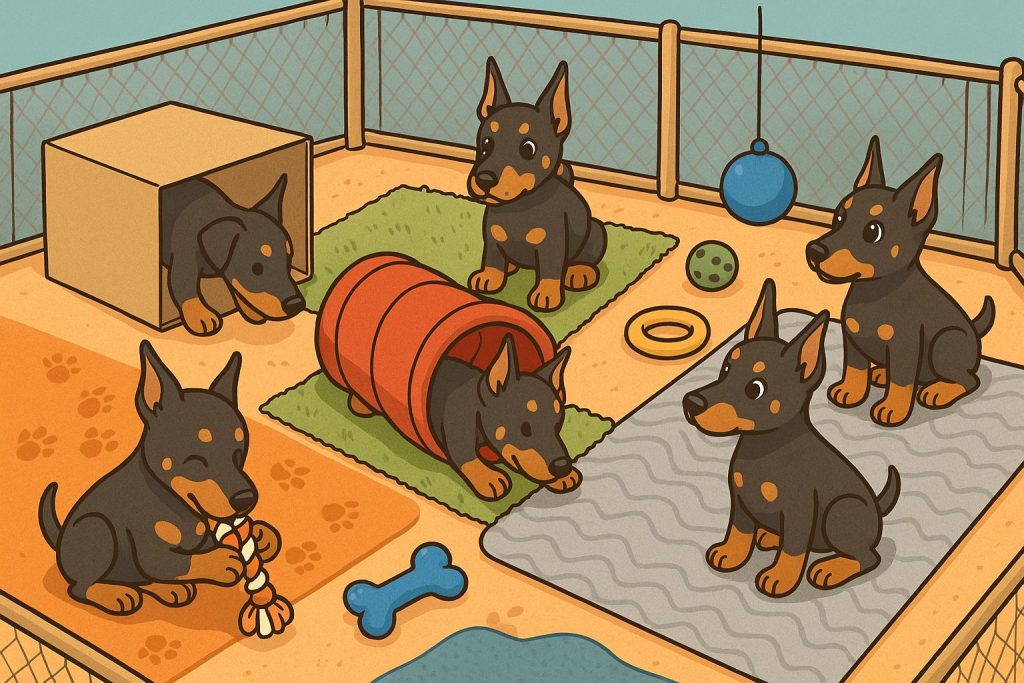
Dobermans are intelligent and sensitive. They need good socialization to grow into confident adults.
Ask the breeder:
- How do you expose puppies to different sounds, people, and experiences?
- What steps do you take to help them feel safe and curious?
- Do you use any early training techniques, like crate introduction or potty training?
A good breeder will be proud to explain this in detail.
6. Can you tell me about the Doberman breed and whether it suits my lifestyle?
Reputable Doberman breeders don’t just want to sell you a puppy. They care about where their dogs go and whether the breed fits your life.
Be honest about your:
- Work schedule
- Activity level
- Family situation
- Training experience
A good breeder will help you decide if a Doberman is the right match for you.
7. How are the mothers treated?

This is a crucial question. You want to be sure the breeder takes excellent care of their breeding females.
Ask:
- How many litters does each female have before retiring?
- Do you skip heats or breed back-to-back?
- Where do the mothers live (in the home or in kennels)?
Ethical breeders:
- Let females fully recover between litters
- Retire them young enough to enjoy life as pets
- Provide a clean, comfortable environment
8. What is included with the puppy?
Before you commit, clarify exactly what you will get when you bring your puppy home.
Common things included are:
- First vaccinations
- Microchip
- Deworming records
- Starter food
- A blanket or toy with the mother’s scent
- Pedigree papers or registration
9. At what age do puppies go to their new homes?
Puppies should never leave their litter before 8 weeks old. Staying with mom and siblings helps them learn important social skills.
Some breeders prefer to keep puppies until 10–12 weeks, which can also be beneficial for their development.
10. Can I see the registration papers for the parents?
Registration papers prove that your puppy comes from purebred parents.
Why this matters:
- It helps you understand the dog’s lineage
- You can look for excessive inbreeding
- You can verify titles and health clearances
Tip:
Don’t hesitate to ask the breeder to walk you through the pedigree if you don’t understand it.
11. What is your health guarantee? Can you explain it fully?
Many breeders offer a “health guarantee.” But read the fine print carefully. Some breeders promise to “replace the puppy” if genetic problems develop, but no loving owner wants to give their dog back.
Look for:
- A guarantee of at least 2.5 years (since many genetic diseases appear after 2 years)
- Clear information about what conditions are covered
- Options besides simply returning the puppy (some breeders help cover treatment costs)
12. May I visit your home or facility?
Seeing the environment in person tells you a lot about how puppies are raised.
When you visit, observe:
- Is the space clean and well-kept?
- Do the puppies look healthy and curious?
- Do the adult dogs seem happy and friendly?
13. Can I meet the puppies’ parents?
Meeting the mother (and ideally the father) is a great way to see the temperament you might expect in your puppy.
Watch for:
- Confidence and calmness
- Clean, healthy appearance
- Friendly, social behavior
14. What support do you provide after I bring the puppy home?
A good Doberman breeder doesn’t disappear once you pay. They should be available to help with questions about training, health, and adjustment.
Ask if you can contact them anytime and if they will remain a resource as your puppy grows up.
15. Do you require a spay/neuter contract?
Many breeders have rules about breeding rights. You may be required to spay or neuter your puppy by a certain age unless you have specific arrangements.
Make sure you understand and agree with any contract before signing.
16. What do you feed your puppies?
Sudden changes in diet can upset your puppy’s digestion. Find out what the breeder is feeding so you can gradually transition if you prefer a different food.
17. If I can no longer care for the dog, what happens?
A reputable Doberman breeder will always take a dog back, no matter how old it is.
This protects Dobermans from ending up in shelters or rescues.
18. Have any puppies from previous litters had serious health or behavior problems?
An honest breeder will be transparent about their breeding history.
Red flag:
If they claim every puppy has been perfect and no issues have ever come up, they may not be truthful.
19. Do you dock tails or crop ears? At what age?
Depending on where you live, tail docking and ear cropping may be routine, optional, or illegal (see the full post here).
Ask:
- If procedures are done, who performs them?
- How are puppies cared for during recovery?
- Can you choose whether the puppy has these alterations?
20. Do you and your dogs participate in any dog sports and activities?

Having Champion, Grand Champion titles in Conformation (see our explanatory post on Dog Shows here) is not about ‘bragging rights’ but ensures that the potential parents of your puppy indeed conform to the standard of the breed, both physically and mentally. Moreover, Dobermans absolutely love all sorts of activities with their humans: Obedience, Agility, Scent Work, IGP / IPO, etc. (You can check our post on all the activities you can do together with you Doberman here) Engaging in those sports, even at novice levels, allows the dogs to live fulfilled and happy lives.
Therefore, if the potential Doberman breeder has no titles at all and does no sports with any of the numerous organizations – this at very least rises some serious questions.
Final Thoughts
Choosing a Doberman breeder is a big decision. The questions you ask today will protect you and your puppy in the long run.
Remember:
- A good breeder will never rush you.
- They will happily answer all your questions.
- They will care as much about where their puppies go as you care about bringing one home.
Take your time, trust your instincts, and don’t be afraid to walk away if something doesn’t feel right. A healthy, well-adjusted Doberman is worth the wait.