
Lumbosacral Transitional Vertebrae (LTV) in Dogs
When people talk about dog health, they often think of hips, elbows, or heart testing. But there is another condition, far less known to the general public, that plays a major role in orthopedic health and breeding soundness: Lumbosacral Transitional Vertebrae (LTV).
LTV is not as “famous” as hip dysplasia, yet its impact can be equally devastating—especially for large, athletic breeds like the Doberman. Left unrecognized, it can predispose a dog to back pain, neurological issues, mobility challenges, and even reduce working ability.
In this article, we’ll take a long, detailed look at LTV: what it is, how it develops, how it’s diagnosed, the different grades, and what responsible owners and breeders need to know.
What is Lumbosacral Transitional Vertebrae?
The dog’s spine is made of multiple vertebrae, each with a distinct role:
- Cervical vertebrae (neck) – 7 bones
- Thoracic vertebrae (chest) – 13 bones, each paired with ribs
- Lumbar vertebrae (lower back) – 7 bones
- Sacral vertebrae (pelvis) – fused, usually 3 bones
- Caudal vertebrae (tail) – variable in number
In a healthy dog, the lumbar spine transitions cleanly into the sacrum. But in some dogs, this transition is abnormal. Instead of a clear boundary between the last lumbar vertebra (L7) and the sacrum, the last lumbar vertebra takes on characteristics of a sacral bone or vice versa.
That is Lumbosacral Transitional Vertebrae (LTV)—a congenital malformation where the spinal anatomy is altered in the lumbosacral junction.
Why Does LTV Matter?
At first glance, LTV might seem minor—just a bone shaped a little differently. But the consequences can be serious:
- Spinal Instability – Abnormal structure can weaken the lumbosacral junction, leading to instability when the dog moves.
- Nerve Compression – The sciatic nerve roots pass through this region; malformed vertebrae can cause compression, resulting in pain or neurological signs.
- Osteoarthritis & Degeneration – Abnormal biomechanics often lead to premature arthritis, worsening with age.
- Breeding Implications – LTV is heritable. Breeding affected dogs risks passing it down to future generations.
For working and performance dogs—like Dobermans in obedience, protection, or agility—the impact can be devastating. Pain, reluctance to jump, or weakness in the hindquarters are common long-term outcomes.
The Inheritance of LTV
Studies in breeds such as the German Shepherd, Boxer, and Doberman suggest that LTV is inherited in a polygenic manner (influenced by multiple genes). This means:
- It does not follow a simple dominant/recessive pattern.
- Environmental factors (nutrition, growth, injuries) can influence the severity of symptoms.
- Careful selection in breeding can reduce prevalence over time.
Because LTV often doesn’t show obvious symptoms in young dogs, X-ray screening is essential for breeders who want to reduce its spread.
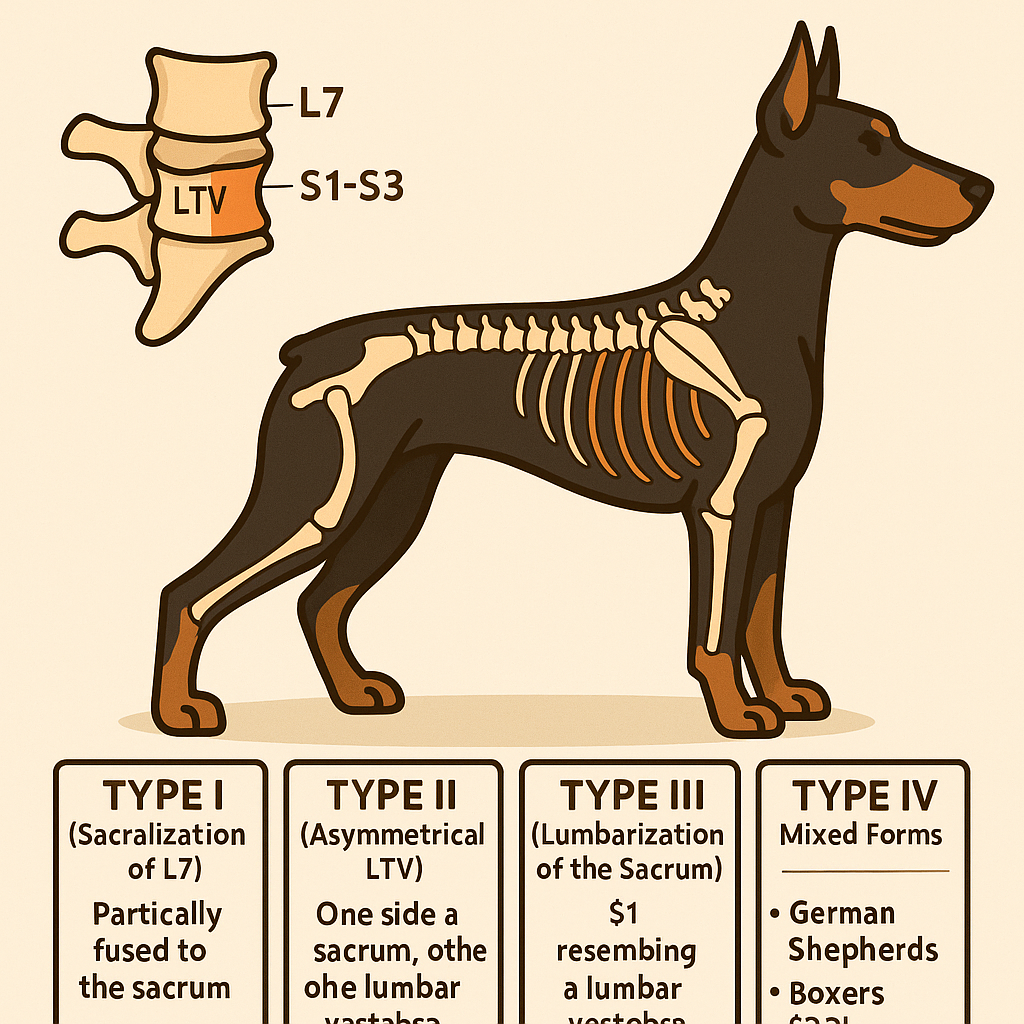
Classification of LTV
Veterinary radiologists typically classify LTV into four main types:
- Type I (Sacralization of L7)
- The last lumbar vertebra is partially fused to the sacrum.
- Type II (Asymmetrical LTV)
- One side looks like a sacrum, the other like a lumbar vertebra.
- This asymmetry is especially problematic because it alters biomechanics unevenly.
- Type III (Lumbarization of the Sacrum)
- The first sacral vertebra resembles a lumbar vertebra, essentially adding an “extra lumbar.”
- Type IV (Mixed Forms)
- A combination of sacralization and lumbarization.
Severity varies. Some dogs live symptom-free their whole lives, while others develop crippling issues by middle age.
Symptoms of LTV in Dogs
Not all dogs with LTV show symptoms. But when they do, signs may include:
- Stiffness in the lower back
- Pain when getting up or lying down
- Reluctance to jump, climb stairs, or perform certain movements
- Weakness in the hind legs
- Bunny-hopping gait
- Incontinence in severe cases (loss of nerve control)
These symptoms often mimic hip dysplasia, which is why misdiagnosis is common.
Diagnosis of LTV
LTV cannot be reliably diagnosed by palpation or clinical signs alone. Imaging is required.
- X-rays (Radiographs) – The most common screening method, often recommended for breeding dogs.
- CT or MRI – Provides more detail, useful if surgical planning is needed or symptoms are severe.
- Differential Diagnosis – Vets must rule out hip dysplasia, degenerative myelopathy, or simple arthritis.
For breeders, the recommended approach is standardized radiographic screening before breeding. Many kennel clubs and health organizations now encourage or require this.
Prevalence in Different Breeds
Research shows that Lumbosacral Transitional Vertebrae (LTV) is far from rare. While it doesn’t get the same level of attention as hip dysplasia, studies across multiple breeds confirm that it appears consistently in breeding populations:
- German Shepherds – Prevalence is reported between 3–15%, depending on the study and population tested. Because the German Shepherd is one of the most heavily studied breeds for orthopedic disease, these numbers are considered fairly reliable.
- Boxers – Multiple studies place prevalence around 8–12%, with many citing a consistent ~10% rate. Boxers also show a relatively high percentage of asymmetrical (Type II) LTV, which is particularly problematic.
- Dobermans – Data for Dobermans is still emerging, but both screening initiatives and orthopedic literature suggest prevalence is 5–8% on average, with some reports going slightly higher (up to 10% in certain lines). Because many Dobermans are not screened for LTV unless symptoms appear, the real rate is likely closer to 7–10% in the general population.
Underreporting and Silent Spread
One of the challenges with LTV statistics is that many dogs live symptom-free for years, especially in their youth. A Doberman with mild or symmetrical LTV may show no outward problems until middle age, when arthritis or nerve compression begins.
This silent period creates two major issues:
Breeding risk – A dog may appear healthy, earn performance titles, and still unknowingly pass LTV to its offspring. By the time symptoms emerge, the genetic contribution may already be widespread in a bloodline.
Underreporting in studies – If only symptomatic dogs are imaged, prevalence appears lower than it really is.
In short: while the numbers vary slightly by study, breeders and veterinarians should consider LTV a common orthopedic concern in working breeds, with Dobermans likely affected at ~7–10% prevalence.
LTV in Dobermans
Dobermans are a breed particularly vulnerable because of their athleticism and the physical demands placed on them. A dog with subtle spinal instability may compensate for years, but the constant jumping, sprinting, and turning required in sports can accelerate degeneration.
At Wonder Doberman, this is why we place such emphasis on spinal health in addition to hips, elbows, and heart. A Doberman should be strong, balanced, and pain-free throughout its working life. Breeding without screening for LTV risks producing litters where performance and longevity are compromised.
Treatment and Management of LTV
Unfortunately, LTV cannot be “cured.” It is a congenital condition. But symptoms can be managed:
Conservative Management
- Weight control – keeping the dog lean reduces spinal stress.
- Joint supplements – glucosamine, chondroitin, omega-3s.
- Physical therapy – hydrotherapy, targeted strengthening.
- Pain management – NSAIDs or gabapentin when needed.
Surgical Intervention
In severe cases where nerve compression is advanced, surgery may be considered to stabilize the lumbosacral junction or relieve compression. However, outcomes vary and costs are high.
Lifestyle Adjustments
- Avoid excessive stair climbing.
- Limit repetitive jumping.
- Use ramps for cars or beds.
Implications for Breeding Programs
For ethical breeders, LTV screening must be part of the program—just like hips, elbows, and cardiac testing.
Key guidelines:
- X-ray all breeding dogs – before the first litter.
- Exclude affected dogs from breeding – especially asymmetrical or severe cases.
- Keep detailed health records – track LTV occurrence in related lines.
- Educate puppy buyers – transparency builds trust and helps families plan for long-term health.
The goal is not to “eliminate” LTV overnight (which is impossible with polygenic inheritance), but to systematically reduce its prevalence through responsible choices.
LTV vs Hip Dysplasia – A Common Confusion
Owners often hear “hip problem” when their dog is stiff, but the underlying issue may be spinal.
- Hip dysplasia affects the ball-and-socket joint.
- LTV affects the lumbosacral junction.
Because both cause rear-limb pain, only proper imaging can distinguish them. A breeder who tests only hips may miss LTV entirely.
Case Study: A Working Doberman
Consider a Doberman in protection training. For the first three years, he performs well—fast, agile, powerful. At age four, he begins refusing jumps. At five, he shows weakness in his hindquarters. X-rays reveal LTV Type II.
This scenario is not uncommon. Without screening, a dog may pass on LTV before symptoms appear, spreading the problem to an entire bloodline.
Responsible Breeding Practices and LTV
At Wonder Doberman, we emphasize:
- Pre-breeding screening for LTV.
- COI tracking – avoiding unnecessary inbreeding, which may concentrate hidden risks.
- Full transparency with puppy buyers.
- Breeding only the healthiest stock – because a Doberman’s life should be long, strong, and free of preventable pain.
Owner Awareness: What You Can Do
Even if you are not a breeder, awareness of LTV helps you make better decisions:
- Ask breeders if they test for LTV.
- Monitor your dog for back pain or hind-limb weakness.
- Get imaging early if signs appear—don’t assume it’s “just arthritis.”
- Adapt your home to reduce spinal strain.
Prevention is Better than Cure
Like so many inherited conditions, prevention lies in responsible breeding and early screening. No supplement, therapy, or miracle cure can undo a malformed vertebra. But informed choices can reduce suffering for future generations.
Conclusion
Lumbosacral Transitional Vertebrae may not be a household term, but for breeds like the Doberman, it should be. It is a silent but significant threat to soundness, performance, and quality of life.
By spreading awareness, encouraging breeders to test, and educating owners, we can reduce its impact. A Doberman—or any dog—deserves to live without preventable spinal pain.
At Wonder Doberman, we remain committed to full transparency, thorough testing, and breeding choices guided by science—not shortcuts.