
Bikejöring With Your Dog: A Thrilling Sport With Serious Considerations
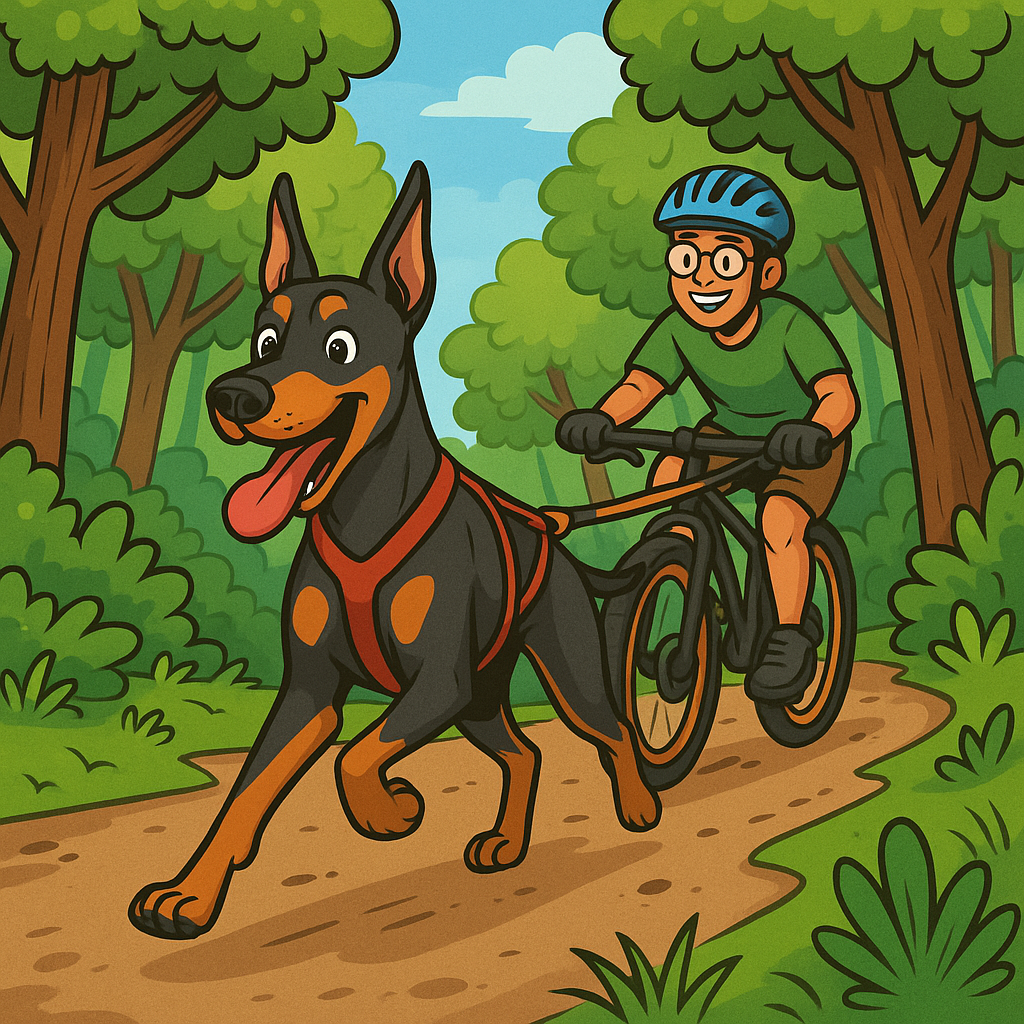
If you’ve ever seen a dog zooming ahead of a mountain bike down a forest trail, tongue lolling in joy and tail wagging like mad, you’ve probably witnessed bikejöring in action. It’s fast, it’s exciting, and it looks incredibly fun—for both dog and human. We’ll be the first to admit: it does look awesome. But also… a little intense, right?
Here at Wonder Doberman, we don’t do bikejoring with our own dogs. Not because we don’t like the idea – we think it’s a fantastic sport! – but because it’s not the right fit for our personal routine and dogs’ specific training focus. That said, we know quite a few people who do Bikejoring with Dobermans regularly and absolutely love it. So if this post inspires you and you’d like to give it a try, we can happily connect you with experienced bikejoring handlers and trainers who can help you get started safely.
Let’s dive into what bikejoring is, what you and your dog need to be prepared, the potential dangers, and how to make it safe and enjoyable for your canine athlete.
Table of Contents
What Is Bikejoring?
Bikejöring (pronounced bike-yer-ing) is a dog-powered sport where one or two dogs are harnessed and attached by a bungee line to a mountain bike. Your dog runs ahead, pulling and guiding while you ride behind—steering, braking, and managing speed. It’s a cousin of canicross (where you run with your dog pulling you) and skijöring (on skis), both of which fall under the umbrella of dryland mushing.
Bikejoring is gaining popularity among dog owners who love high-energy outdoor adventures and want to keep their working breeds physically and mentally stimulated. Dogs love to run, and many of them, especially active, driven breeds like Dobermans, Huskies, Malinois, and GSPs, thrive in this kind of work.
But while it may look like a fun, casual outdoor activity, bikejöring is not something to take lightly. There are serious risks involved if you or your dog aren’t prepared.
Is Bikejoring Safe for Dogs?
It can be. But it also can be incredibly dangerous—if not approached with the right preparation, training, and equipment.
Let’s be honest for a second. Imagine this: You’re flying down a dirt path at 30 km/h, your dog pulling hard up front, ears alert, tail up. You’re in sync, flying as a team… until a squirrel darts across the path.
Suddenly, your perfectly focused companion is now a torpedo of squirrel-seeking fury. You have half a second to react before you either crash into a tree, get yanked over the handlebars, or watch your dog veer into a ditch at full speed.
Bikejöring isn’t just a physical activity, it requires serious obedience, self-control, and environmental awareness from both the dog and the human. That’s why it’s crucial to train smartly and take safety seriously.
What Makes Bikejöring Dangerous (And How To Make It Safer)
Potential Dangers:
- Injury to the dog from overexertion, pulling too young, or running on hard or hot surfaces
- Joint or muscle strain, especially in growing puppies or dogs not in peak condition
- Accidents from unexpected distractions (wildlife, other dogs, people)
- Equipment failure or poor-quality gear leading to injury
- Heatstroke in warm weather
- Crashes involving the bike, the rider, or the dog
How To Reduce Risk:
- Never start before the dog is physically ready. No pulling sports for growing puppies. Wait until growth plates are closed, usually around 18 months for medium to large breeds.
- Use proper gear. This includes a professionally-fitted pulling harness, bungee line, and a bike antenna to prevent the leash from tangling in your front tire.
- Train progressively. Don’t just hook up your dog and start pedaling. Build up to it with structured groundwork (more on that below).
- Condition your dog. They need cardio and muscle fitness to pull safely. Think of it like preparing for a marathon.
- Obedience first. Your dog must be responsive to commands like “whoa” (stop), “gee” (right), and “haw” (left). They must also resist chasing prey mid-run.
- Avoid hot weather. Run early mornings or in cool weather only. Dogs overheat easily while running.
- Stay on soft terrain. Dirt trails are best—avoid pavement to protect your dog’s joints and paws.
Before Bikejöring with Doberman, What Training do we need?
You don’t want to find yourself halfway down a trail realizing your dog has no idea what “stop” means. This isn’t the place to learn on the job. A dog trained for bikejöring needs to have:
Solid Obedience Training
Your dog needs to:
- Walk on leash politely
- Be able to work off-leash under voice control (even if they’re always attached during bikejöring)
- Come when called, even under distraction
- Leave small animals or other dogs alone
- Focus on the job and ignore chaos
A solid obedience foundation is non-negotiable. Many bikejöring enthusiasts start with obedience competitions or working titles like BH or CD to prove their dogs are mentally reliable under stress.
Start With Canicross
Canicross (running while your dog pulls in a harness) is the perfect introduction. It helps teach pulling mechanics, trail commands, and teamwork—without the added risk of a bicycle. You’ll learn how to move together, how to stop, turn, and deal with distractions. Plus, you’ll build your dog’s endurance gradually.
If your dog can’t handle canicross, bikejöring is too advanced. Don’t skip steps.
Conditioning & Fitness
Pulling is a serious athletic activity. Your dog needs:
- Strong core and back muscles
- Healthy joints
- Endurance
- Paw conditioning
Off-season or indoor work on a treadmill can help maintain fitness safely. Structured treadmill sessions also help your dog build focus and work ethic.
Swimming, hiking with a weighted backpack, and controlled jogs are all great pre-bikejöring conditioning.
Training Trail Commands
Common trail commands include:
- “Hike!” – Go / move forward
- “Whoa!” – Stop
- “Easy!” – Slow down
- “Gee!” – Turn right
- “Haw!” – Turn left
- “On by!” – Ignore distraction and keep going
- “Leave it!” – Do not chase that squirrel (a must!)
These commands can be trained during walks, hikes, and canicross before ever touching a bike.
What Kind of Dog Can Do Bikejöring?
Bikejöring is best suited to high-energy, driven dogs with stamina and focus. Breeds often seen in the sport include:
- Siberian Huskies
- Alaskan Malamutes
- German Shorthaired Pointers
- Dobermans
- Belgian Malinois
- Vizslas
- Eurohounds (sled dog mixes)
That said, any healthy, athletic dog over 18 months can participate with proper preparation.
Bikejöring is not appropriate for:
- Brachycephalic breeds (Pugs, Bulldogs)
- Dogs with joint problems
- Dogs who are reactive or fearful
- Puppies under 18 months
And always talk to your vet before starting.
What Gear Do I Need for Bikejöring with Doberman?
Here’s your basic starter kit:
For the Dog:
- Pulling harness – Not a regular walking harness. Needs to distribute pressure properly across the chest and shoulders.
- Bungee line (2–3 meters) – Absorbs shock between the bike and dog.
- Neckline (if using two dogs) – Connects their collars to keep them in sync.
- Booties (optional) – Protect paws on rough terrain or in snow.
For the Bike:
- Bike antenna – Keeps the line from tangling in the front tire.
- Mountain bike – Front suspension helps on bumpy trails.
- Disc brakes – Powerful stopping is critical.
- Helmet, gloves, eye protection – Safety first!
Don’t go cheap on gear. Poorly made equipment can injure your dog—or you.
What’s a Good Age to Start Training?
You can start obedience and basic trail commands young, even with a puppy. Use hikes and walks to practice turns, stops, ignoring distractions, and polite leash behavior.
Physical pulling shouldn’t start until at least 18 months for medium-to-large breeds. Their joints and growth plates need to be fully developed. You can transition from canicross to bike once they’ve proven their fitness and command reliability.
How Often Can You Do Bikejoring?
Even elite dogs don’t bikejör every day. It’s tough on the body. Most handlers do it 2–3 times a week, with conditioning and training in between.
Pay close attention to your dog’s recovery time, hydration, appetite, and general attitude. If they seem sore or hesitant, stop and reassess.
Should You Try It?
If you have:
- A high-energy dog
- A solid training foundation
- A love of speed and the outdoors
- The time to train properly
- Access to safe trails
…then yes, bikejoring might be your next big adventure!
But if you:
- Have a dog who’s reactive, fearful, or has health issues
- Don’t have time to train gradually
- Hate cold weather or dirt trails
- Can’t ride a bike confidently off-road
…maybe it’s not the right sport and that’s okay!
Need Help Getting Started?
As we mentioned at the top—we don’t do bikejöring with our own Dobermans, but we have several friends and connections who do it seriously and can help you.
If this sport has piqued your interest, send us a message. We’ll happily connect you with the right people, whether it’s a trainer, a local group, or just someone to answer your questions.
Final Thoughts
Bikejöring is more than just a wild ride—it’s a relationship-building activity that demands trust, communication, and training. Done right, it can be one of the most exhilarating and rewarding ways to work with your dog. Done wrong, it can be dangerous.
Don’t let the adrenaline rush override your planning. Build the foundation, prepare your dog, and start slow. If your dog truly loves to pull and you enjoy the ride, this could become your favorite sport.
And remember: squirrel encounters are inevitable. What your dog does in that moment will depend entirely on the work you put in before you hit the trail.
Let us know if you want to be connected with experienced bikejöring folks—we’d love to help.
Stay safe and enjoy the adventure!