
Degenerative Myelopathy in Dogs: Understanding the “Dog ALS”
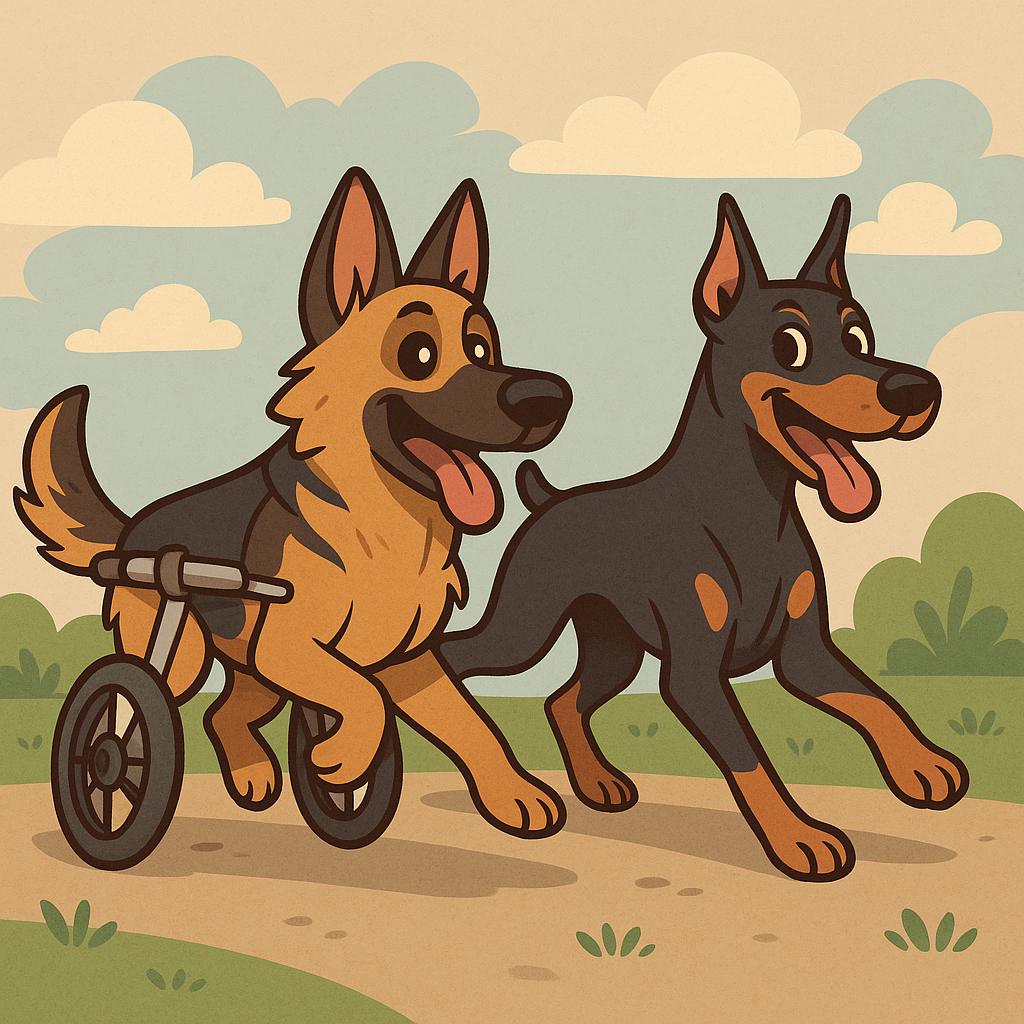
Degenerative Myelopathy in dogs (DM) is a heartbreaking diagnosis for any owner. Sometimes called the canine equivalent of ALS (Amyotrophic Lateral Sclerosis) in humans, this progressive spinal cord disease slowly robs dogs of their ability to walk and control their hindquarters. It’s a condition that involves no pain, but the emotional toll is significant—for both dog and owner.
Despite its severity, many dog owners have never even heard of DM until their dog begins stumbling, dragging a paw, or showing weakness in the back legs. And because symptoms can mimic arthritis or other age-related issues, it’s often misdiagnosed or caught too late. Worse still, many breeders continue to produce puppies without ever testing for this devastating disease.
At Wonder Doberman, we believe knowledge is power. In this blog post, we’ll cover everything you need to know about Degenerative Myelopathy: what it is, how it’s diagnosed, which breeds are affected, how DNA testing works, and what to expect if your dog is diagnosed. We’ll also discuss life expectancy, symptom management, and why ethical breeding matters—even in breeds considered “low risk.”
Table of Contents
What is Degenerative Myelopathy?
Degenerative Myelopathy is a progressive disease of the spinal cord in dogs. It’s caused by a mutation in the SOD1 gene—the same gene implicated in some forms of ALS in humans. This mutation results in the slow degeneration of the white matter of the spinal cord, which is responsible for transmitting nerve signals between the brain and the limbs.
The condition most commonly begins in middle-aged to older dogs, generally between 7 and 14 years old. It starts subtly—slight weakness in the rear limbs, dragging toes, stumbling—and gradually progresses to full paralysis of the hind limbs. In later stages, it can even affect the front limbs and respiratory muscles.
Unlike arthritis or orthopedic conditions, Degenerative Myelopathy is not painful. But it is progressive and irreversible, eventually robbing your dog of their mobility and independence.
Symptoms of Degenerative Myelopathy
In the early stages, the symptoms can be mild and easy to confuse with normal aging or mild arthritis. As the disease progresses, signs become unmistakable.
Early Symptoms (Stage 1):
- Hind limb weakness
- Slight dragging of rear paws (often resulting in worn nails on one foot)
- Wobbliness when walking
- Difficulty rising from a lying position
- Occasional knuckling of the paws (walking on top of the foot)
Intermediate Symptoms (Stage 2):
- Increased difficulty walking
- Swaying or “drunken” gait (ataxia)
- Crossing of back legs while walking
- Incontinence (bowel and bladder control may be affected)
- Muscle loss in hind limbs
- Inability to stand without help
Advanced Symptoms (Stage 3 and Beyond):
- Complete paralysis of rear limbs
- Front limb weakness
- Loss of tail movement
- Difficulty breathing (in very late stages)
- Pressure sores due to immobility
Despite the paralysis, dogs with DM do not show signs of pain. They often remain mentally sharp, interested in their environment, and eager to interact with their families.
How Degenerative Myelopathy in dogs is Diagnosed?
There is no single definitive test to diagnose Degenerative Myelopathy during life, but it can be strongly suspected with a combination of clinical signs, breed predisposition, and diagnostic ruling-out of other conditions.
Diagnostic Process:
- Neurological exam – A vet may notice proprioceptive deficits (poor awareness of paw placement), reduced spinal reflexes, or ataxia.
- X-rays and MRI/CT – Used to rule out orthopedic or spinal conditions like intervertebral disc disease or spinal tumors.
- Cerebrospinal fluid analysis – May be used to check for inflammation or infection.
- DNA Testing for SOD1 mutation – The most important step in confirming genetic predisposition.
It’s important to note that DM is a diagnosis of exclusion—other conditions must be ruled out before assuming DM is the cause of symptoms.
DNA Testing: The SOD1 Mutation
The good news is that a simple and affordable DNA test can determine whether a dog carries the SOD1 mutation linked to Degenerative Myelopathy.
Important Warning About DNA Testing Labs:
Not all DNA testing companies are created equal. Some consumer-focused brands are more about marketing than science, and unfortunately, Embark has gained a reputation among breeders for delivering inaccurate or misleading results—not just for Degenerative Myelopathy, but across many genetic health conditions. False negatives, false positives, and inconsistent reports are far too common.
At Wonder Doberman, we do not recommend Embark for any health testing.
For accurate, breeder-trusted results, we strongly recommend using reputable diagnostic labs such as:
- Canine Health Check
- Neogen
- UC Davis Veterinary Genetics Laboratory (VGL)
These labs have a long-standing track record for scientific accuracy, veterinary oversight, and reliability. When it comes to your dog’s health—and the future of the breed—precision matters.
The Three Possible Results:
- Clear (N/N): The dog has two normal copies of the gene. They will not develop DM and cannot pass it on to offspring.
- Carrier (A/N): The dog has one normal and one mutated gene. They are unlikely to develop DM, but can pass the mutated gene to their puppies.
- At Risk (A/A): The dog has two copies of the mutated gene. They are at a high risk of developing DM at some point in their life.
It’s important to understand that not every dog with two copies (A/A) will develop the disease—some never show symptoms, while others progress rapidly. Environmental factors, modifier genes, and unknown influences likely play a role.
Still, knowing your dog’s genetic status can help you plan for the future—and more importantly, it helps breeders make ethical decisions.
Breed Predisposition: Who Is at Risk?
Degenerative Myelopathy was first recognized in German Shepherds, and they remain one of the highest-risk breeds today. However, the disease has since been identified in more than 100 breeds.
High-Risk Breeds:
- German Shepherd Dogs
- Pembroke Welsh Corgis
- Boxers
- Chesapeake Bay Retrievers
- Bernese Mountain Dogs
- Rhodesian Ridgebacks
- Poodles (Standard and Miniature)
- Siberian Huskies
- Collies
Breeds With Documented Carriers or Low Incidence:
- Doberman Pinschers
- Golden Retrievers
- Labrador Retrievers
- Great Danes
- Australian Shepherds
- Weimaraners
While Dobermans are not considered a high-risk breed, affected individuals have been identified, which means ethical breeders should still test. At Wonder Doberman, we screen all our breeding dogs for the SOD1 mutation, even if our lines have never shown symptoms. That’s how responsible breeding works—you prevent problems before they happen.
Should Breeders Test Dogs in “Safe” Breeds?
Yes—absolutely.
Even in breeds not commonly affected, carriers and “at risk” dogs exist. If two carriers are bred together, 25% of the litter may be at risk, even if the breed is not on the typical DM list.
Testing is simple, affordable, and non-invasive. There is no excuse for skipping it—especially when the consequences are so severe for future dogs and families.
By choosing only “clear to carrier” or “clear to clear” matings, breeders can ensure no puppy is born at risk. It’s not just responsible—it’s ethical.
Prognosis and Life Expectancy
Degenerative Myelopathy is, sadly, a terminal condition. The disease is progressive and irreversible.
Timeline (Varies by Dog):
- Stage 1 (Early signs): 6–12 months
- Stage 2 (Paralysis of hind limbs): 6–12 months
- Stage 3 (Advanced weakness, front limbs): Final months
From the time of diagnosis, most dogs live about 6 months to 2 years, depending on care, environment, and the individual rate of progression.
It’s important to note that DM does not cause pain, which is a rare silver lining. Dogs remain alert, affectionate, and interested in life. That’s why many owners opt for wheelchairs and home accommodations to extend their dog’s quality of life.
Is There a Cure?
Unfortunately, there is no cure for Degenerative Myelopathy.
There is no medication that will halt or reverse the disease. However, supportive care and physical therapy can significantly slow progression and improve your dog’s quality of life.
Managing Degenerative Myelopathy
While you can’t stop the disease, you can help your dog live better and longer with the right tools.
Physical Therapy
- Underwater treadmill: Gentle exercise that builds muscle without stress on joints.
- Range-of-motion exercises: Helps preserve mobility and prevent stiffness.
- Strengthening activities: Tailored to your dog’s ability level.
Mobility Aids
- Dog wheelchairs: Give your dog independence after hind-limb paralysis.
- Lifting harnesses or slings: Assist with stairs, bathroom breaks, and short walks.
- Boots or socks: Protect dragging paws from injury.
Environmental Adjustments
- Non-slip flooring or rugs
- Ramps instead of stairs
- Orthopedic beds
- Easy-access water bowls
Supplements (Talk to Your Vet First)
- Vitamin E
- B-complex vitamins
- Omega-3 fatty acids
- Acetyl-L-carnitine
- Aminocaproic acid (sometimes recommended)
These won’t cure DM but may support nerve function and slow progression when combined with physical therapy.
Emotional Support and End-of-Life Decisions
Caring for a dog with DM is emotionally draining. Watching a once-active, strong dog lose mobility can feel like a slow heartbreak. But remember—they’re not in pain. What they value most is being with you.
Here are some emotional realities to consider:
- Daily care is labor-intensive: bathroom assistance, repositioning, hygiene, etc.
- Incontinence is common: Some dogs lose bladder/bowel control.
- You may need to make tough choices: When mobility is gone and quality of life is low, euthanasia may become the kindest option.
Still, many owners report that dogs with DM remain mentally happy and loving. As long as your dog is still enjoying life—eating, wagging, engaging—it’s worth continuing their care.
Final Thoughts: Prevention is the Best Medicine
Degenerative Myelopathy is not contagious. It’s not caused by food or trauma. It’s not something you can vaccinate against or treat with antibiotics.
It’s purely genetic.
The only real way to prevent it is through responsible breeding.
At Wonder Doberman, we test all our breeding dogs for the SOD1 gene—even though our breed is not considered “high-risk.” Why? Because:
- The test is easy.
- The condition is devastating.
- And ethics come before profits.
We encourage every breeder, regardless of breed, to test their dogs. We also encourage puppy buyers to ask for proof. If a breeder can’t show you genetic results for DM, walk away.
Because no family should ever have to face this disease without warning.
If you have a dog diagnosed with DM, know this: you are not alone, and you’re doing your best. And if you’re a breeder—or buying a puppy—do your part to stop this disease at the source.
At Wonder Doberman, we stand for health, ethics, and the future of the breed. That includes testing for every known issue—even the rare ones.
If you have any questions about DM, SOD1 testing, or want to see our health guarantees and testing results, please contact us. We’re always happy to help.