
The Ortolani Test in Dogs: Why We Don’t Rely on It—and When It Can Do Harm
Overview (for busy readers)
- What it is: The Ortolani test in dogs is a hands-on maneuver (usually under heavy sedation) used to feel a “clunk” as a loosened hip reduces back into the socket: an indicator of hip laxity associated with canine hip dysplasia (CHD). [1]
- Why vets use it: It’s quick, cheap, and part of many orthopedic workups, especially in growing dogs to decide if early surgeries (JPS, TPO/DPO) are worth discussing. [2]
- The big problems: Results vary with age, positioning, sedation, pain, muscle tone, chronic joint changes, and examiner skill; negatives do not rule out disease, and positives do not predict how a dog will feel or function later. [3]
- Risk of harm: The “Barlow/Ortolani” sequence is a provocative test—Barlow intentionally subluxates a lax hip, and Ortolani reduces it. Per orthopedic teaching, this is done under deep sedation to avoid guarding and pain; performed roughly or repeatedly, it can inflame soft tissues and, by pediatric analogy,forceful repetitions are specifically warned against because of iatrogenic cartilage injury. [4]
- What we do instead: Use quantitative imaging to inform breeding and clinical choices: PennHIP distraction index (DI) for laxity risk and high-quality radiographs (OFA/FCI/BVA schemes for phenotyping at maturity). PennHIP is the best-validated early predictor of osteoarthritis risk.
Table of Contents
What the Ortolani Test in Dogs Actually Does (and Doesn’t)
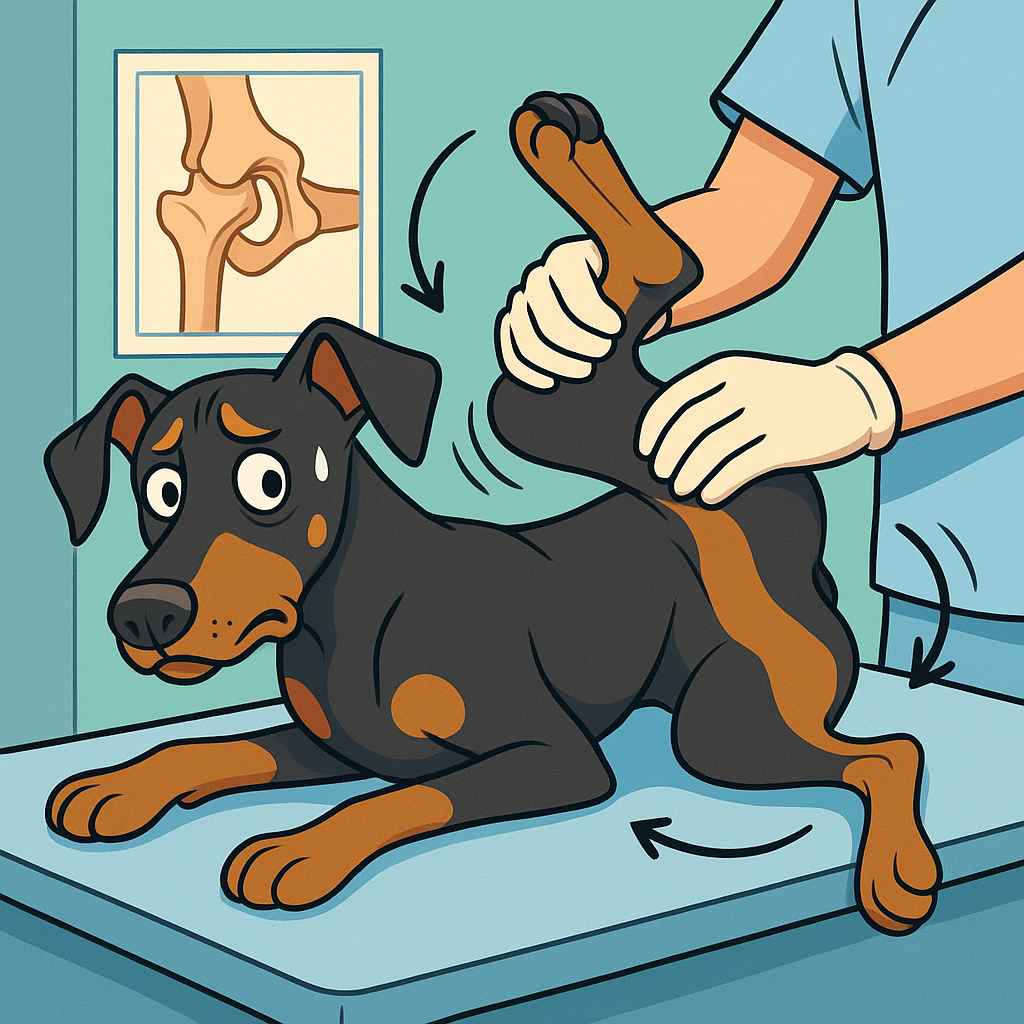
The Ortolani test in dogs is a palpation technique to demonstrate hip laxity in a young dog. In practice, clinicians almost always perform it under heavy sedation or general anesthesia because muscle tone and pain can mask or mimic the sign. The examiner applies axial force to the femur (Barlow) to provoke subluxation, then slowly abducts the limb; an audible/palpable “clunk” as the femoral head reduces is considered a positive Ortolani sign.
This maneuver has been in veterinary use for decades, adapted from human pediatrics. It’s a standard part of many orthopedic assessments, especially between roughly 10–16 weeks to flag severe laxity that might guide early interventions (JPS or TPO/DPO) and activity management.
But here’s the catch: the test is qualitative—a yes/no “feel”—and its result is not a diagnosis on its own. Orthopedic reviews are explicit: no single clinical sign is definitive for CHD; these tests should be part of a sequential workup alongside imaging. [5]
Key truth: A negative Ortolani test in dogs does not mean “normal hips.” Chronic capsular thickening and remodeling can eliminate the palpable “clunk,” hiding laxity; conversely, a positive sign doesn’t predict how the dog will do functionally [3].
Why It’s So Unreliable as a Standalone Screen
Age and disease stage
In very young puppies, generalized ligamentous laxity can confuse the finding; in older dogs, fibrotic joint capsule and osteoarthritic changes can eliminate the sign despite underlying disease. That’s why a negative Ortolani in an older adolescent/adult is not reassuring.
Positioning matters (a lot)
Research comparing dorsal vs. lateral recumbency shows differences in what examiners feel, and inconsistency in grading mild versus moderate signs. In one study, dorsal recumbency performed better, but variability remained. That is not the mark of a dependable, reproducible test.
Operator dependence and muscle tone
Sedation decreases muscle guarding, but it also changes joint tone altering what’s felt. Examiner experience and how much force is used further affect outcomes. Standards bodies therefore recommend performing the test under deep sedation or GA and always correlating with imaging.
The false-negative problem
Even surgery-oriented guidance for general practitioners warns that a negative Ortolani test in dogs does not guarantee healthy hips later, especially if degenerative changes are already underway.
The false-prediction problem
A positive Ortolani test in dogs indicates laxity at that moment; it does not tell you whether the dog will be lame later, nor does it quantify risk of osteoarthritis with the precision breeders need. Reviews caution against using the Ortolani sign to predict future DJD on its own.
Bottom line: Treat Ortolani test in dogs as a clue, not a conclusion. When high-stakes decisions (breeding, surgery, or heavy restrictions) are on the line, a qualitative “clunk” is not enough.
Can the Ortolani (and Barlow) Cause Harm?
Short answer: Yes, if done improperly, roughly, or repeatedly. Longer answer:
- The Barlow component is explicitly described as a provocative test designed to subluxate a lax hip; Ortolani then reduces it. By definition, you are creating and then reducing abnormal joint movement. That is why authoritative sources insist on sedation/anesthesia and proper technique.
- Sedation is recommended not only for reliability but to minimize pain and guarding, because forcing the maneuver in awake, resisting dogs can strain periarticular tissues. Specialist centers describe the test as being performed under heavy sedation or GA.
- While veterinary studies rarely document acute iatrogenic injury from a single Ortolani maneuver (because no ethics board would green-light repeated forcible subluxations in puppies), pediatric orthopedic literature does warn that repeated or forceful Barlow/Ortolani maneuvers can cause iatrogenic cartilage damage or dislocation in infants, underscoring why these are performed gently and sparingly by trained clinicians. It’s reasonable to use this as a cautionary parallel for dogs, given the shared mechanics of the tests. (This is an inference from human data.) [6]
Real-world breeder risk: In a busy clinic or teaching setting, multiple staff “feeling the clunk” on the same puppy is not rare. That means multiple provoked subluxations in one visit, unnecessary trauma for a growing hip. If your puppy is sore for days after an exam like this, that’s your sign too.
Practical rule: If someone suggests an Ortolani on a growing dog, it should be once, gentle, sedated, and only if the finding will actually change the plan—and immediately followed by quantitative imaging rather than repeated manipulations.
What the Evidence Says When We Compare Tests
PennHIP (Distraction Index) vs. Ortolani
Multiple studies across decades show PennHIP DI is more accurate at predicting later osteoarthritis than qualitative palpation. One landmark comparison found DI the most accurate predictor in puppies as young as 16–18 weeks; Norberg angle was better on distraction than on OFA-style extended views. [7]
A later study comparing early-age exams reported Ortolani test in dogs had high sensitivity (~92%) good at catching many lax hips while PennHIP had better specificity, PPV, and overall accuracy – better at telling you which dogs truly progress to disease. For breeding and long-term planning, specificity and accuracy matter more.
PennHIP gives you a number (DI) between 0 and 1: <0.3 is tight and low risk; the risk of OA rises as DI increases above ~0.3. Breed distributions let you compare your dog to others in the breed instead of guessing from a “clunk.”
OFA/FCI/BVA radiographic schemes
Traditional extended-hip radiographs phenotype the joint (Excellent → Severe) but are less predictive at very young ages; even ACVS notes that relying on very early OFA-style films misses the ideal window for JPS/DPO. Use prelims for a snapshot and finals at maturity, but don’t pretend those replace quantitative laxity measures while the dog is growing.
Clinical examination role (where Ortolani fits)
Clinical signs (pain on extension, bunny-hopping, gait, atrophy), Barlow/Ortolani/Barden can triage cases for imaging but none of these maneuvers is definitive for CHD. They are adjuncts, not arbitrators.
How the Ortolani Test in Dogs Fails in the Real World (Examples)
The “normal today, lame tomorrow” adolescent: 9-month old large-breed dog presents with a stiff bunny-hop after weekend play. The clinic does an awake Ortolani—no clunk felt (dog is guarding), calls it “normal,” sends him home. Three months later, radiographs show remodeling and OA. This is a classic false-negative pathway described in reviews, where capsular thickening and pain mask the sign.
The teaching-hospital puppy: 14-week-old with obvious laxity. Two students and a resident each perform the test “to feel it.” Puppy limps for two days. This is exactly why it’s supposed to be sedated, gentle, and not repeated; Barlow/Ortolani are provocative maneuvers.
The “positive clunk = surgery now?” misstep: A young dog with a positive sign gets pushed toward aggressive surgery based only on palpation. When PennHIP and quality radiographs are finally performed, DI is moderate, conformation acceptable, and conservative management with conditioning and weight control is appropriate. A “clunk” alone shouldn’t launch a family into irreversible procedures.
Causes Behind Unreliable Ortolani Results
Developmental stage – Hyperlaxity in early weeks, then capsular fibrosis in later stages can hide or distort the sign.
Position/technique – Dorsal vs. lateral recumbency changes what you feel; studies show different performance between positions.
Sedation depth – Too light → guarding (false negative); too deep → altered tone (possible overcalling). That’s why experienced hands and correlation with imaging matter.
Chronic changes – Thickened capsule and acetabular remodeling can eliminate the palpable reduction even in dysplastic hips.
Pain and fear – Awake dogs resist, masking laxity or producing painful spasms that mimic “clunks.” This is precisely why heavy sedation/GA is recommended in reputable centers.
Safer, Smarter Pathways: What to Ask For Instead
For puppies (8–20 weeks)
- Skip repeated Ortolanis. If a clinician proposes it, ask: “Will the result change what we do today?” If yes, insist on sedation and one gentle attempt by the most experienced person in the room, then proceed to imaging immediately.
- PennHIP for quantitative laxity (DI) at 16+ weeks with a trained provider. This is the best-validated way to estimate future OA risk and to inform early interventions or activity plans.
- Targeted radiographs to evaluate conformation and rule out co-morbidities (e.g., spinal or stifle contributions to gait changes). Even ACVS emphasizes that both special radiographs and palpation (if used) require sedation.
For adolescents/adults (10–24 months+)
- OFA/FCI/BVA films at the recommended ages to phenotype hips at maturity (and prelims if you need a look earlier). Don’t over-interpret a single clinical sign at this stage.
- Use DI + phenotype together: DI quantifies laxity risk; phenotype documents structural changes. That combo is far more informative than a binary “clunk/no clunk.” Antech Diagnostics
Tips, Warnings, and “What to Say at the Clinic”
If someone proposes an Ortolani on your young dog:
- “Please sedate and keep it gentle—I don’t want repeated attempts.” (Reputable sources describe this test under heavy sedation/GA in specialty settings.)
- “If it’s positive or negative, we still plan to confirm with PennHIP/quality radiographs, correct?” (A negative Ortolani does not rule out disease; a positive doesn’t quantify risk.)
- “Let’s avoid multiple demonstrations for students—one examiner only.” (Barlow deliberately provokes subluxation; repetition adds stress without adding value.)
Red flags
- Awake Ortolani in a resisting dog.
- Multiple repeat maneuvers “so others can feel it.”
- Treatment plan based primarily on a palpation sign rather than imaging.
Safer defaults
- Lead with PennHIP (16+ weeks) for a number (DI). Use OFA/FCI/BVA as phenotyping at maturity.
- For painful dogs, prioritize analgesia, controlled activity, weight management, and targeted imaging over repeated manipulation. (Orthopedic consensus emphasizes multimodal management; palpation adds little once pain is obvious.)
Breeder Insights (Wonder Doberman approach you can stand behind)
Data over drama. We don’t make keep/drop breeding decisions on a “clunk.” We measure DI and we document phenotype at maturity. That gives us both risk and structure, not guesswork.
Protect growing joints. We decline repeated Ortolani demonstrations and request sedation if the maneuver is truly necessary once never three times so everyone “gets a feel.”
European transparency, North American practicality. We value the rigorous transparency common in European schemes (FCI) but pair it with PennHIP, which is the most evidence-based early predictor of OA risk. Together, these standards reduce the chance of unpleasant surprises for families years down the road.
Owner education. We explain to families why a clinic “clunk test” isn’t destiny—and how numbers (DI), radiographs, fitness, and body condition truly move the needle on hip outcomes.
Step-by-Step Plan We Recommend
- 8–10 weeks (if concerns): Skip routine Ortolani unless it changes action today. If done, insist on sedation and single gentle attempt, then proceed to imaging as indicated.
- 16–18+ weeks: PennHIP DI with a certified provider. Use DI to set expectations, exercise plans, and discuss whether JPS is warranted within the shrinking window.
- 5–10 months: Re-evaluate gait and comfort. Consider DPO/TPO discussion only with imaging evidence and appropriate conformation—never from palpation alone.
- 12–24 months: Final OFA/FCI/BVA films at the correct ages for formal phenotype. Combine with DI history for breeding decisions. OFA
The Takeaway
The Ortolani test in dogs is not benign and not definitive. It’s a provocative maneuver that can add discomfort if repeated and, used alone, is unreliable for breeding or long-term planning.
Numbers beat “clunks.” PennHIP DI predicts risk; quality radiographs document phenotype. Use both.
As breeders and owners, you’re within your rights to decline repeated manipulations, to request sedation if a single Ortolani will truly alter next steps, and to insist on imaging for decisions that matter.
Final thoughts
Nothing here replaces your veterinarian. It explains why we (as ethical breeders) decline repeated Ortolani “clunk checks,” ask for sedation if a single maneuver is genuinely needed, and insist on quantitative imaging for decisions that affect a dog’s whole life. If your clinician is open to dialogue, share this article and ask to build a plan around PennHIP + proper radiographs, not a momentary “feel.”