
Collagen, Ear Structure, and Arthritis in Dogs: What Every Doberman Owner Should Know
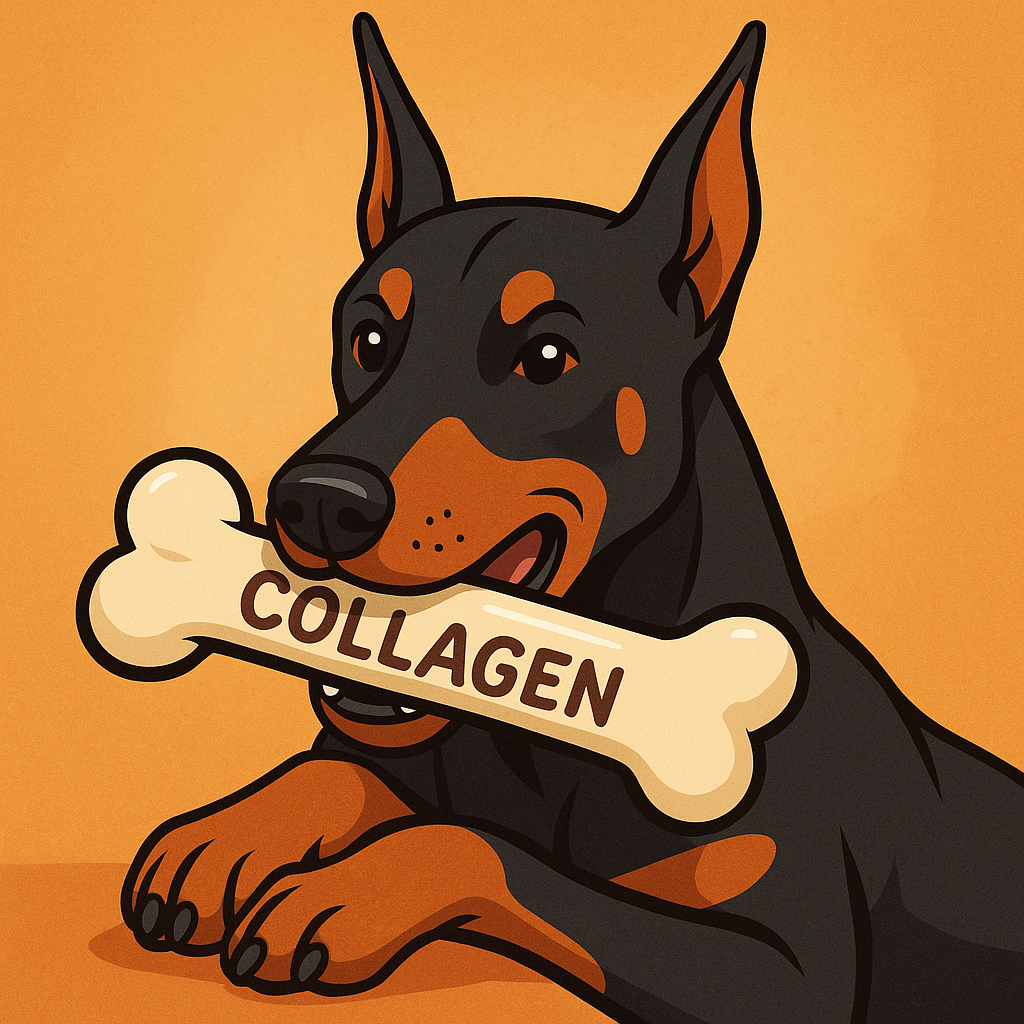
When we think about collagen, most people immediately associate it with human skincare and anti-aging products. However, collagen for dogs plays an even more crucial role: it’s the foundation of healthy joints, cartilage, ligaments, skin, and even ear structure. For Doberman owners, understanding collagen is especially important because it impacts not only the look of your dog’s ears but also their long-term joint health.
In this article, we’ll explore the fascinating connection between collagen, ear cartilage, and arthritis, including a groundbreaking study originally done on cats, and explain how these findings relate directly to Dobermans.
Table of Contents
Collagen for Dogs: What It Is and Why It Matters
Collagen is the most abundant protein in your dog’s body. It’s like the scaffolding that keeps everything together, providing strength and flexibility to:
- Cartilage → gives structure to ears and joints
- Ligaments & tendons → keeps movement smooth and stable
- Skin & connective tissues → maintains elasticity and strength
- Bones & joints → supports healthy mobility
When collagen levels are balanced, your Doberman will have firm ear cartilage, strong ligaments, and smooth joint function. But when collagen production is too low or too high, problems arise:
- Too little collagen → weak cartilage, floppy ears, unstable joints
- Too much collagen → overly stiff cartilage, decreased flexibility
This delicate balance is where things get very interesting for Doberman owners.
A Genetic Study on Cats That Changed Everything
A surprising study [1, 2] on cats revealed just how important collagen is — not only for looks but also for joint health.
The Goal
Researchers wanted to create a breed of cats with naturally soft, folded ears that didn’t stand upright. To achieve this, they selectively bred cats with lower collagen density in their ear cartilage, making it softer and less rigid.
The Outcome
It worked… at least visually. The cats were born with adorably folded ears, different from the upright ears of other breeds.
But there was an unintended consequence:
- These cats showed significantly higher rates of early-onset arthritis.
- The lowered collagen levels didn’t just affect their ears — it also impacted their joints, ligaments, and cartilage health throughout the body.
This study proved something critical:
Collagen doesn’t just affect ear shape — it affects overall musculoskeletal health.
When Collagen Levels Are Too High: The Other Side of the Story
Interestingly, further studies revealed that the opposite problem is just as dangerous.
- When collagen levels are too high, cartilage becomes hard, brittle, and less flexible.
- Over time, this stiffness can cause microscopic joint damage, increasing the risk of arthrosis (arthritis).
This means both extremes — too little or too much collagen — can negatively impact your dog’s health. For Dobermans, genetics play a huge role in where they naturally fall on this spectrum, and this is where the differences between European and American Dobermans become fascinating.
Collagen and Ear Structure in Dobermans
Dobermans are a unique breed when it comes to ear cartilage thickness. While many owners focus on ear cropping laws, the genetic differences in natural ear cartilage between European and American Dobermans are significant.
European Dobermans
- Have thicker, firmer ear cartilage
- Higher natural collagen density
- Ears typically stand on their own faster after cropping — often within 2–4 weeks
- Tend to experience fewer posting complications
American Dobermans
- Generally have softer, thinner ear cartilage
- Lower natural collagen density
- Ears can take several months to stand properly, even with excellent posting techniques
- More prone to prolonged posting sessions and ear collapse
These differences are not cosmetic, they are biological. The thickness and firmness of the ear cartilage are directly linked to collagen production.
Ear Posting Challenges and Collagen Balance
If you’ve ever wondered why some Doberman owners struggle for months to get their dog’s ears standing, while others seem to have perfectly upright ears within weeks, collagen is often the answer.
Why European Dobermans Have an Easier Time
- Firmer cartilage = ears stand faster
- Less dependence on long-term posting
- Stronger collagen fibers provide natural support
Why American Dobermans Need More Help
- Softer cartilage = longer posting schedules
- Even slight errors in posting technique can cause permanent folds
- Requires careful nutritional support for cartilage development
This explains why breeders in Europe rarely face posting issues, while many U.S. breeders spend months carefully maintaining ear posts before the ears stabilize.
Collagen and Arthritis in Dobermans
The findings from cat studies, combined with long-term Doberman health data, suggest a fascinating trend:
- European Dobermans: Fewer reported cases of early-onset arthritis
- American Dobermans: Higher incidence of arthritic changes, especially in middle age
Why? The leading theory is collagen balance:
- European Dobermans’ thicker cartilage and stronger joints seem to offer better long-term support
- American Dobermans’ softer cartilage may lead to greater joint strain, especially during athletic activity
However, having too much collagen isn’t ideal either, as it can make joints and cartilage excessively stiff, which may lead to long-term mobility issues. At Wonder Doberman, we focus on finding the perfect balance through responsible breeding. We love many aspects of the European Doberman lines: especially their stronger structure, firmer ear cartilage, and generally better health statistics and we tend to favor them in our program.
That said, we also recognize that American Doberman lines bring certain qualities we appreciate, such as elegance, refinement, and sometimes a slightly softer temperament that can be desirable for specific families. For this reason, we aim to produce litters with 50% to 100% European lineage, carefully combining the strengths of both lines.
Our goal is to avoid producing puppies that lean too far toward the American collagen profile, where ear cartilage tends to be softer and joint issues more common. Instead, we strive to maintain a healthy, balanced collagen level in our breeding program — combining the strength and stability of European lines with the refinement and versatility of American ones to create well-rounded, healthy Dobermans.
Ear Cropping Laws and Collagen Genetics
In Canada and many European countries, ear cropping is prohibited by law. However, the genetic differences between European and American Dobermans still exist, regardless of cropping.
- A natural European Doberman’s ears will feel thicker even if left uncropped
- An uncropped American Doberman’s ears often feel softer and thinner
This is essential for breeders and owners to understand, especially when making decisions about importing, posting, or breeding.
Collagen Bones: Do They Really Help?
With the rise in popularity of collagen supplements for humans, many dog owners have started buying collagen for dogs in form of chews, sticks, and bones hoping they will improve joint health, ear cartilage strength, and skin elasticity. But does giving collagen-rich bones actually increase collagen levels in your dog’s body? The answer is: yes and no.
How Collagen Bones Work
When your dog eats a collagen chew or bone, the collagen proteins are broken down during digestion into smaller peptides and amino acids. These components are then absorbed into the bloodstream and used where the body needs them, whether that’s in the joints, skin, cartilage, or ligaments.
So yes, feeding collagen-rich treats can provide the building blocks your dog needs to maintain healthy collagen production. However, there’s a catch:
- Giving your dog collagen bones doesn’t directly “increase” collagen density in the ears, skin, or joints overnight.
- Instead, it supports the body’s natural ability to repair, maintain, and produce collagen where it’s genetically programmed to do so.
Genetics vs. Nutrition
For Dobermans, genetics play the primary role in determining ear cartilage thickness and collagen density. A European Doberman born with firmer cartilage will naturally have stronger ears than an American Doberman, regardless of how many collagen chews you provide.
That said, good nutrition can absolutely make a difference in supporting healthy collagen production and reducing the risk of early-onset arthritis. Collagen bones, when combined with a balanced diet and other nutrients like vitamin C, glucosamine, and omega-3s, can help keep joints and cartilage healthier for longer.
Bottom Line
- Collagen bones are beneficial for joint health, skin, and overall collagen maintenance.
- They do not change your dog’s genetic collagen density or automatically make ear cartilage firmer.
- They’re best used as part of a complete joint-support plan, not as a standalone solution.
How to Support Healthy Collagen in Your Doberman
Whether your Doberman has naturally firm ears or softer cartilage, you can support optimal collagen production and joint health through diet and care.
Nutrition Tips
- High-quality protein → provides amino acids for collagen synthesis
- Vitamin C → essential for collagen production
- Omega-3 fatty acids → reduce joint inflammation
- Bone broth → rich in natural collagen and glucosamine
Joint & Cartilage Supplements
- Collagen peptides
- Glucosamine & chondroitin
- MSM (methylsulfonylmethane)
- Hyaluronic acid
Always consult your veterinarian before introducing supplements, especially if your dog has existing joint issues.
Wonder Doberman’s Commitment to Collagen & Joint Health
At Wonder Doberman, we pay close attention to genetics, collagen balance, and long-term joint health when selecting our breeding dogs.
- We prioritize European bloodlines for their thicker cartilage and better collagen balance
- All our breeding dogs undergo comprehensive health testing
- Our goal is to reduce the risk of early-onset arthritis while maintaining the beautiful, strong ear structure Dobermans are known for
Your dog’s health always comes first and understanding collagen is one of the keys to raising strong, athletic, and healthy Dobermans.
Conclusion
Collagen plays a huge role in your Doberman’s overall health, affecting:
- Ear cartilage firmness
- Joint stability
- Arthritis risk
- Recovery after posting
The studies on cats have taught us an important lesson: messing with collagen levels has far-reaching consequences. For Dobermans, genetics create natural differences between European and American lines — and understanding these differences helps owners make informed choices.
At Wonder Doberman, we combine scientific knowledge with responsible breeding practices to give our dogs the healthiest start in life possible.